
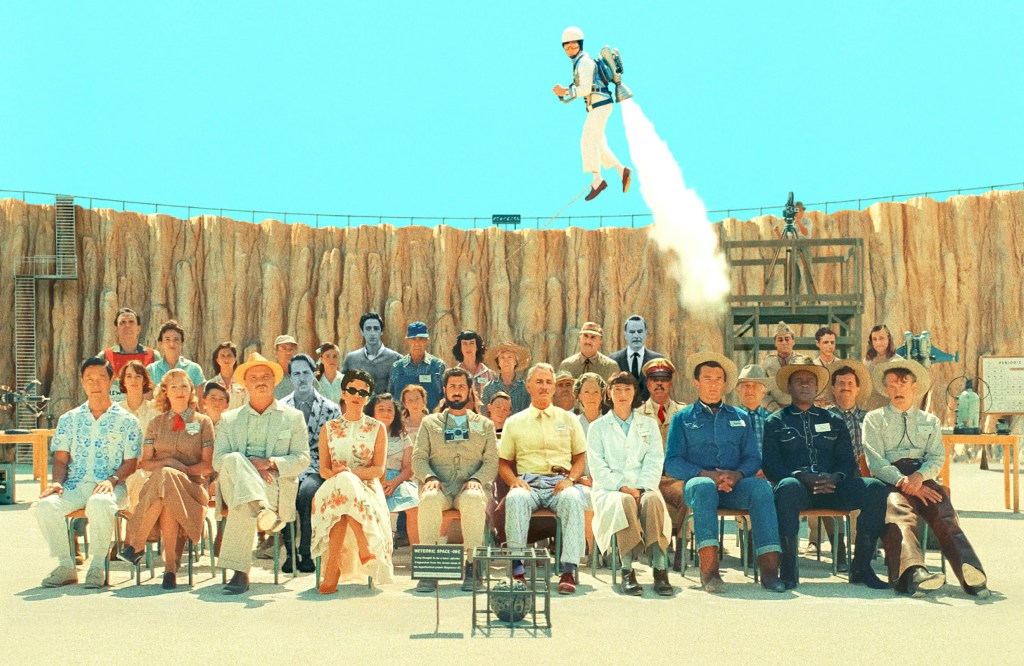
Wes Anderson is a director people don’t seem to fully understand. On the surface it’s easy to infer the charm of his work comes from his heavy use of pastel color palettes and symmetrical scene framing. If you’ve been hanging around TikTok and other social media, you’ve most likely seen those AI generated re-imaginings of films like Star Wars and Lord of the Rings in his style. While these are occasionally cute, it also kind of confines the public sentiment of the director to just his quirky visual style. And while this is a huge part of his appeal, it’s worth noting that the impact of his work goes well beyond this. His films often offset their themes of loss, nostalgia and varying family dynamics with a quirky, theatrical approach which has made a lot of people love his style and a lot of people absolutely hate it. And I feel pretty confident in saying if you don’t like his style, this new film is absolutely not going to win you over.
Asteroid City is a meta reflection on our place in the universe and if there’s really a purpose out there. It’s a story within a story and a framework within a framework, all tying together those aforementioned themes in such a unique, albeit confusing way that is just pure Wes. The performances maintain the signature offbeat energy the director is known for, balancing both humor and heart in a way that admittedly missed the mark for me occasionally. Yet the visuals and specificities of the world Anderson crafts are still just as gorgeous as always, and in the end, he’s managed to craft something so familiar yet so unique that I don’t think AI would ever be able to touch.
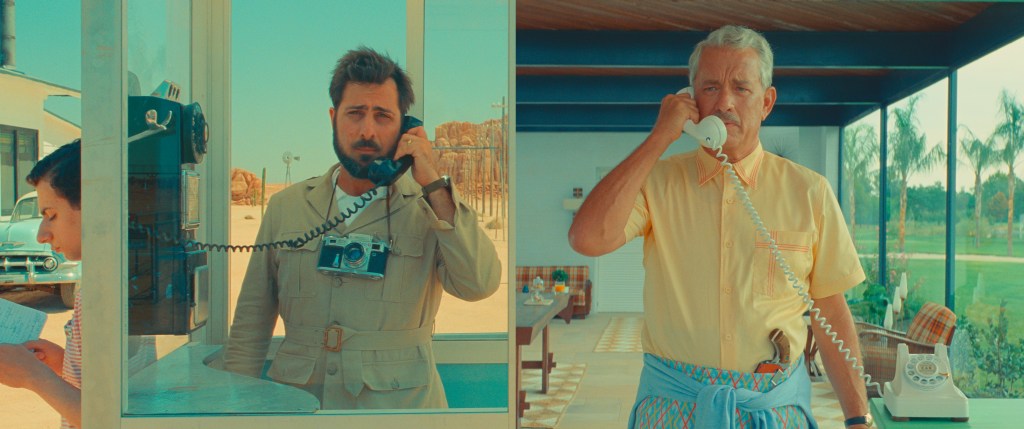
Like I said there’s two stories intertwined in the film; a play called Asteroid City, which is where most of the conflict takes place, and the formation of the play itself, with the writer and actors trying to figure out what it all means. But I guess if you had to simplify it a bit, the film mostly centers around the visitors of the fictional Asteroid City, a tiny desert pit stop home to a crater, a bunch of cactuses and a research facility studying the cosmos. We mostly focus on Augie Steenbeck, a recently widowed war photographer traveling with his genius son Woodrow and his other 3 daughters. He meets famous actress Midge Campbell and the two hit it off while also interacting with a colorful assortment of characters that all become stuck in Asteroid City through an extraterrestrial event. The narrative often switches between this narrative and the more meta narrative of the play’s production itself, which can really spin your head at times. Yet you never really feel all that distant from the core conflict, even if it’s about a story that isn’t really happening. I will say, these black and white peeks behind the curtain are arguably less interesting as the colorful world where the main plot resides, but I can recognize their importance to the bigger picture for the most part. This multi-tiered style of storytelling isn’t all that unfamiliar to Anderson’s work, but here I think it begs for the most attention to it if you really want to understand how and why the story is being told like this.
Unsurprisingly, the visuals are certainly gorgeous. The heavy use of oranges and blue really nail this midwest postcard feel for the main story, while the tale of the story’s development is shown in black and white for era accuracy. The practical sets help create a setting that feels real and grounded enough while also having an ever-so-slight artificial aura to it that mostly makes you aware of the story’s theater origins while never actually feeling like you’re watching a stage play. As a matter of fact, when the film is focused on the “real world”, these scenes are crafted and presented in a way far more akin to a play, maintaining the 180 degree rule, utilizing spotlights, and often addressing the audience directly. It’s a nice little element that I found to be pretty unique for a story like this, especially when the lines between the two stories start to blur as the film moves into its climax. While maybe not the most outlandish or intricately constructed visuals from Anderson, it’s still 100 percent on brand.

As for the performances, I found them all to hit their marks rather well, from the main cast to some of the smaller cameos. There’s a bit of a criticism of Anderson’s work that a lot of his characters sound the same, talking with that signature dry, rapid fire wit. That is mostly the case here, but there is a bit of variety and truthfully, I don’t really mind the similarities. The dialogue moves at such a fast pace that every scene moves right along, with very little wasted space. Most of the time, the dialogue is pretty humorous, with the deadpan deliveries really helping to sell each absurdity. I’d be hard pressed to call this one of his funnier films, I think Grand Budapest Hotel and Moonrise Kingdom might still have him beat there. But each actor does a great job with what they’re given, with a few of the standouts for me being Jason Schwartzman, Scarlett Johansson, Jeffery Wright and even Tom Hanks, who gives one of the best performances I’ve seen from him in a while despite not having a ton of screentime. Most of these characters all find themselves tied to a pretty significant event, which opens them up to discussion about what this event means for them and how the world is perceived.
There’s plenty of existentialism to dissect here, both in the vein of the science fiction backdrop of the main story and the fact it’s presented as a play in the first place. Tons of movies dealing with extraterrestrial events share a similar discussion of the vastness of the universe and our place in, but this is quite possibly the most personal I’ve ever seen a story like this get while also talking about UFOs and aliens. Anderson finds a way to smelt these big feelings down into smaller, everyday issues, like the loss of a loved one, world weariness, receiving recognition not just in success but in your own existence and complete uncertainty of the world around you. As the curtain continues to be peeled back and eventually completely ripped from the rafters, these themes tie into how we perceive and chase art, begging for clear cut meaning before realizing the importance of the pursuit as well. If it sounds like a lot, that’s because it is. The film can be unforgiving at times, and truthfully, I don’t know if these messages always come out super impactful. At times the schtick of having all your characters maintain the same restrained, robotic characterization does feel a bit underwhelming, even if it’s meant to illustrate their humanity being withered down by their surroundings. It’s pretty much par for the course with Anderson’s work and it doesn’t look like it’s going anywhere, so like I said before, this probably is not going to win you over if you’re on the fence with this director.

With that being said, Asteroid City is yet another subversive piece of art from one of the most unique directors working today. It’s full of the type of humor, style and self-reflecting you’ve come to expect from his work, told in perhaps one of the most complex, if not alienating, narrative vehicles in Anderson’s entire filmography. Its quirkiness and heartfelt motives aren’t always as impactful as they could be, but the film is nothing short of an absolute charm to watch thanks to the offbeat writing, the restrained yet comedic performances, and of course, a beautifully and meticulously crafted world of weirdness.
Rating

Little Green Gimlet

Asteroid City is a hot and humid place to adventure to, so we need something a little refreshing to keep us trucking. Enter the Little Green Gimlet, a riff on a classic cocktail given a bit of a greener galactic sheen to fit right at home with the little green men floating not so far outside of the Earth’s atmosphere. And yeah, technically the aliens in the film aren’t green, but that’s beside the point. This cocktail is a nice, refreshing drink that utilizes cucumber, melon and lime juice to make an easily sippable experience. Unlike a Wes Anderson film, it’s actually pretty straight forward and easy to comprehend!
Ingredients
- 2oz gin
- 1/4oz Midori
- 1/2oz lime juice
- 1/2oz simple syrup
- 4 cucumber slices
- Garnish: cucumber spiral
Instructions
- Add all ingredients to a shaker and shake with ice.
- Double strain into chilled martini glass.
- Garnish with cucumber spiral.
 The Martini Shot
One thought on “Asteroid City – REVIEW & COCKTAIL”