

Christopher Nolan is regarded as one of the best directors working today, a man with a distinct style and approach to filmmaking that has resonated with various audiences ranging in tastes. Whether it be through big brained mind benders or grounded, gritty re-imaginings of a comic book icon, Nolan has a track record that cannot be denied. I like to think of him as a concept director; someone whose films typically hinge on a complex idea while occasionally sacrificing a more human element in the story. This isn’t always the case with his work, but I do find myself picking up on this trend in some shape or another every time I catch one of his flicks. But Nolan is more than just a one trick pony, evident by his latest attempt to go a bit more straightforward with his subject matter while also focusing on the dissection of a fairly layered character.
That attempt is Oppenheimer, a historical biopic focusing on Robert J. Oppenheimer, the man credited as the Father of the Nuclear Weapon. His work with the Manhattan Project was pivotal for the ending of World War 2, but the lasting implications of his work have long been a debated topic. This isn’t Nolan’s first rodeo into historical non-fiction, but it is his most secular and investigative. Nolan manages to craft a film that somehow maintains his signature ambitious scope while also primarily focusing on smaller, simpler moments. This creates one of the most unique films in his catalog, and dare I say it, one of his best.

Oppenheimer unravels the gray colored layers of its titular scientist, attempting to grapple with the figure’s historical significance and his moral dilemmas. The 3 hour biopic manages to be tense, nail-biting, and often horrifying despite a rather straightforward, dialogue heavy approach to the story. Championed by an all star ensemble cast and collaborated by true technical wizards, the film is a visual and auditory masterclass that gives depth to one of history’s often forgotten figureheads, and an uncomfortably bleak look into the moment that changed modern war forever.
The film is told in a fractured fashion, spanning Oppenheimer’s early years all the way to post World War 2. We see his impact on quantum mechanics in the US, the development of the atomic bomb, the Trinity Test, the dropping of said bomb, and the attempts to disparage the scientist after he expresses regret. The time jumps can be a tad confusing at times, especially with a side plot involving Lewis Strauss attempting to become Secretary of Commerce, but I think the film does a solid job weaving these differing timelines in ways that narratively make sense. Like I said, it’s perhaps Nolan’s most straightforward film to date that doesn’t involve a guy in a bat-suit. It does demand some attention to understand how all of these instances ultimately connect, but the film itself is so engrossing that I didn’t have too much of a problem with it.
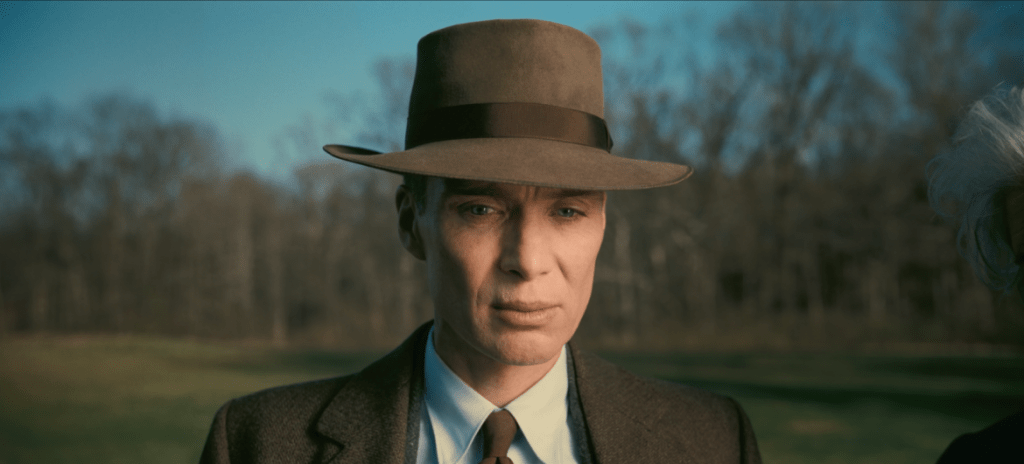
Cillian Murphy’s take on the bomb builder is surprisingly complex and unsurprisingly fantastic. He manages to be a commanding on-screen presence despite being a relatively reserved character. Murphy manages to convey a genuine sense of dread and regret, something that visibly and slowly washes over the character more and more as he reaches his inevitable end. Yet he’s not really a character you root for, but not one you find easy to outright despise. There’s genius in his methods but also a weakness as well, unable to definitively understand what he believes in. Is he a glutton for self-loathing or someone who simply could not understand the ramifications of where he was heading. I’m still not entirely sure, but I’m not sure the film fully knows either. There’s still a bit of ambiguity when it comes to Oppenheimer’s morality that I think I can be satisfied with being unanswered. Regardless, Murphy captures all of the uncertainty, regret, and decay that comes with developing a killing machine, crafting a character that is defined by his greatness as much as his weakness. Supporting Murphy is a large ensemble cast that occasionally only occupies mere minutes out of the runtime, yet there are several pivotal performances worth mentioning. Rober Downey Jr. as Lewis Strauss has got to be a revelation for the actor, who I think a lot of people have just assumed is Tony Stark all the time. Strauss’s looming presence over the story is constantly felt despite his actions taking place well after the most exciting parts of the story. There’s a growing, underlying toxicity to the character that, once it reaches its boiling point, proves how fantastic of an actor RDJ is. Emily Blunt as Katherine, Oppenheimer’s wife, was someone I would’ve liked a little more depth from, yet she becomes a scene stealer at the tail end of the film. She embodies the primal strength to survive Oppenheimer himself comes to sorely lack, managing to wrestle her own demons to fight for the dying respect of her husband, which in turn affects her own respect. Peppering the film are strong supporting roles from the likes of Matt Damon, Florence Pugh, Benny Safdie and Tom Conti, as well as a few surprising cameos and one-off appearances. I had no idea Gary Oldman was in the film, but his two minutes of screen time are just as great as you’d expect.
If there’s one thing you can count on in a Nolan film, it’s technical proficiency, and there’s absolutely no shortage of it here. Like in Dunkirk, Nolan has an impressive eye for historical detail, managing to capture astute authenticity when recreating some of the film’s most iconic moments, like the Trinity Test. Despite the film taking place mostly in a desert or a cramped interrogation room, Nolan manages to still bring his trademark sense of scale to perhaps his most contained and claustrophobic film to date. The cinematography is striking at times, amplified by an impressive devotion to practicality, especially with the sprinkling of explosions and particles often seen throughout the film. As far as I know these were all done practically, imploring a variety of techniques like forced perspective to simulate the splicing of atoms and a harrowing, giant explosion. The film is mostly in color, but there are a few sequences shot in black and white, which I think helps split the film into scenes seen as subjective, in color, and factual, in black and white. It’s an interesting use of this style that I think drives home the fact that we’re often along for the ride in Oppenheimer’s perspective, relying on him as the narrator to get his side of the story.
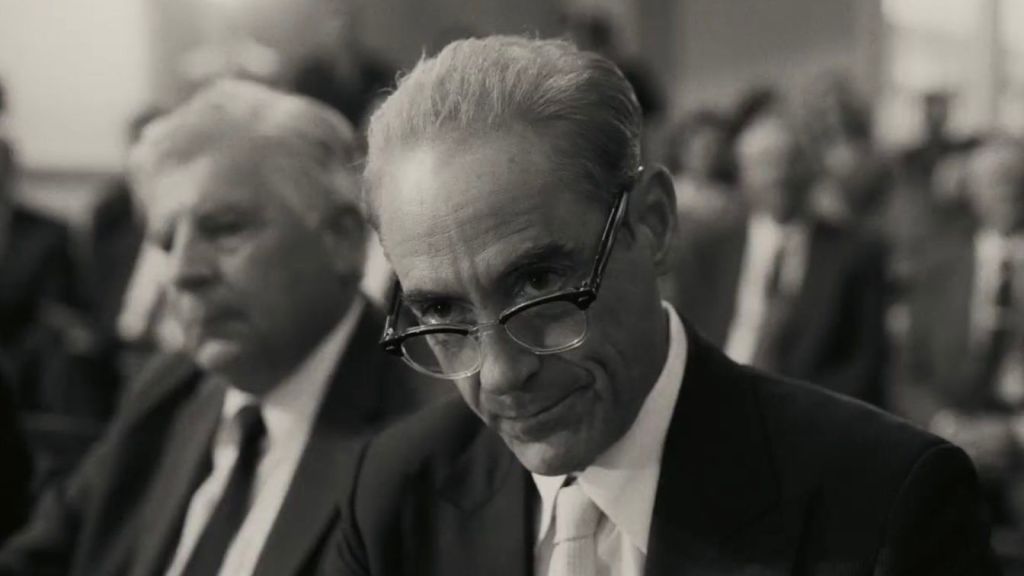
For a film mostly involving people talking, I thought the pacing was done exceptionally well for the most part. The pacing does buckle under the weight of the lengthy runtime, particularly near the tail end of the film, yet the editing remains so engaging throughout that I never felt bored when the film leans towards bureaucratic bickering over big explosions. The fact that he was able to make something like the Trinity Test, an event where we obviously know what happens, so tense and nail-biting is a testament to Nolan’s attentive pacing. It’s not always a straightforward presentation either, as Nolan injects horror-like elements into a few scenes that play with blinding lights, deafening silence, and loud, abrasive noises. These scenes are genuinely unnerving, attempting to materialize the guilt-ridden psyche of the titular character in a way that alienates him from reality. As to be expected with Nolan’s films…it’s a loud one, especially if you’re catching it in IMax. Yet I regret to report that, like Tenet, there’s a lot of poor mixing between Ludwing Goransson’s incredible score and the film’s dialogue. Especially with such a quiet main character; there were definitely a few scenes where what was being said was lost on me because of the audio mixing. I don’t think it’s nearly as bad as Tenet, but I do have to wonder how this happened twice.
The film makes the decision to refrain from showing the act of the bombing of Hiroshima and Nagasaki and the effects it had on the Japanese people, which a few people have been pretty vocal about. I actually think this was a good decision for a few reasons. For starters, there are plenty of stories about this told BY Japanese directors, who will obviously have the most insight into this absolutely horrible moment in human history. If you want more from the victim’s perspective, there’s plenty of films to choose from. There’s Grave of the Fireflies, or if you want something a little more abstract, House is a unique allegory for the nuclear bombings. Hell, Godzilla’s whole existence was based on the fear of nuclear war. You can’t really say these voices haven’t been highlighted, you just need to look in the right places. So now you could be wondering why you should care about a film centered around the making of the weapon rather than those who suffered by it. Firstly; fair question. Secondly, the story had to be told like this to work, because it’s meant to highlight the divide, the separation of humanity these people had when building this weapon, which makes the film all the more horrifying. The fact that one of Japan’s cities was spared simply because an American general honeymooned there shows that these people were so far removed from seeing their targets as fellow humans. Whether or not the bomb was the right decision in the long run is still debatable, but it’s interesting to see how someone like Oppenheimer would handle this kind of legacy. There’s quite a few interpretations you can take away from this story, which I think is true to history.

Christopher Nolan has potentially delivered one of his best here, melding historical biopic and political thriller genres to create a tense critique on not only the craftsman behind the atomic bomb, but the nuclear age that spawned from it. The character work is absolutely an all-timer for Nolan, while the performances feel authentic, grounded, and full of depth. Gorgeously designed from both a visual and auditory perspective, Oppenheimer manages to stand above the cliches and pratfalls of the genre to deliver an introspective take on a huge turning point in history, dissecting the man behind it all. While its momentum doesn’t always remain steadfast, the film is still highly engaging and incredibly somber to sit with. It really shows Nolan’s progression as a director while still holding onto what makes his work so appealing. Maybe this is the one that will finally make Nolan say “I am become Nominee, the winner of Oscars”.
Rating

Trinity Test


If you’re familiar with “bomb” style cocktails, you’ll probably know where this is going. It involves taking a main liquid, typically a beer, and dropping some type of shot concoction into it. I’ve devised my own powerful spin on this style of drink that does require some careful implementation of fire, so as always, please be extra careful when handling flammable materials. The final product will vary slight depending on the beer you use, but I’ve found the beer’s flavor transforms into something toasty, slightly dessert-like, and as expected, incredibly strong. Let’s get testing.
Ingredients
- 1 lager beer
- 3/4 shot of Jagermeister
- 1/4 shot overproof rum
Instructions
- Pour 3/4 of the beer into a pint glass.
- Add the Jagermeister to a shot glass, then carefully layer the overproof rum on top.
- Carefully light the top of the shot on fire.
- Carefully drop the shot into the beer glass.
 The Martini Shot
2 thoughts on “Oppenheimer – REVIEW & COCKTAIL”