

November – 2023
Ridley Scott is master of historical epics
Only historical inaccuracies stand before him
Film Twitter is now a battlefield
Call me dad coded, but I love a good, sweeping movie about history’s most prominent figures when it’s done right. The film has to capture the essence of its subject in a way that is both magnetic but also relatively true to history. It must humanize the demigods we have only ever seen in history textbooks, while still managing to capture the grandeur and magnitude of their impact on the world. It’s gotta take a talented director as well with a lead performance that will sweep award season almost purely because the only thing voters consider a good performance is how closely you can act like another famous person.
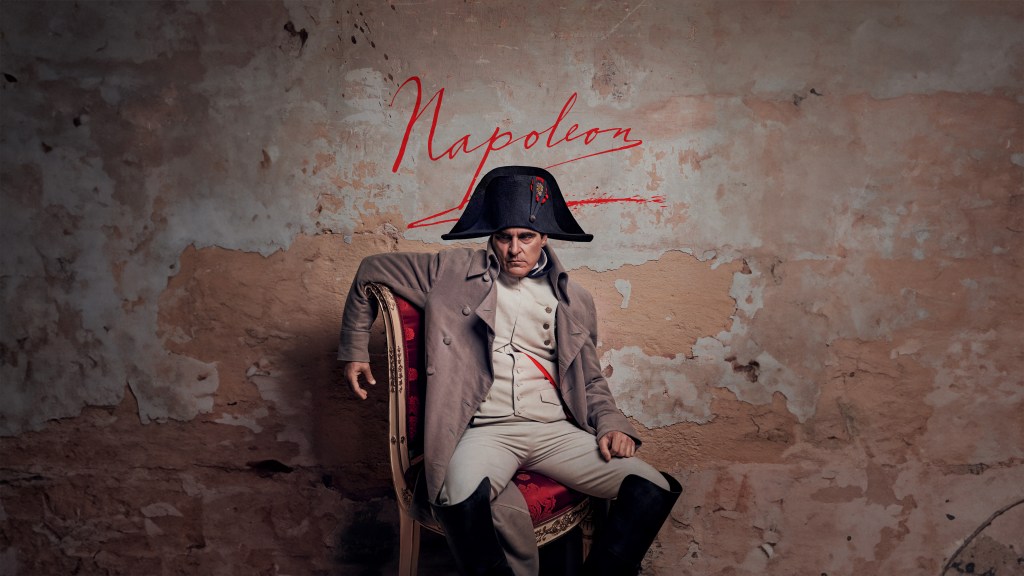
On the chopping block today is Napoleon, the tale of one of history’s most powerful and dominant leaders. Directed by the legendary Ridley Scott and captained by a performance from the adequately legendary Joaquin Phoenix. This is about everything you’d expect; a decade spanning compilation of Mr. Bonaparte’s rise to power, his greatest victories and introspection into a man mostly known for his big funny hats and his height. How tall was he anyway?
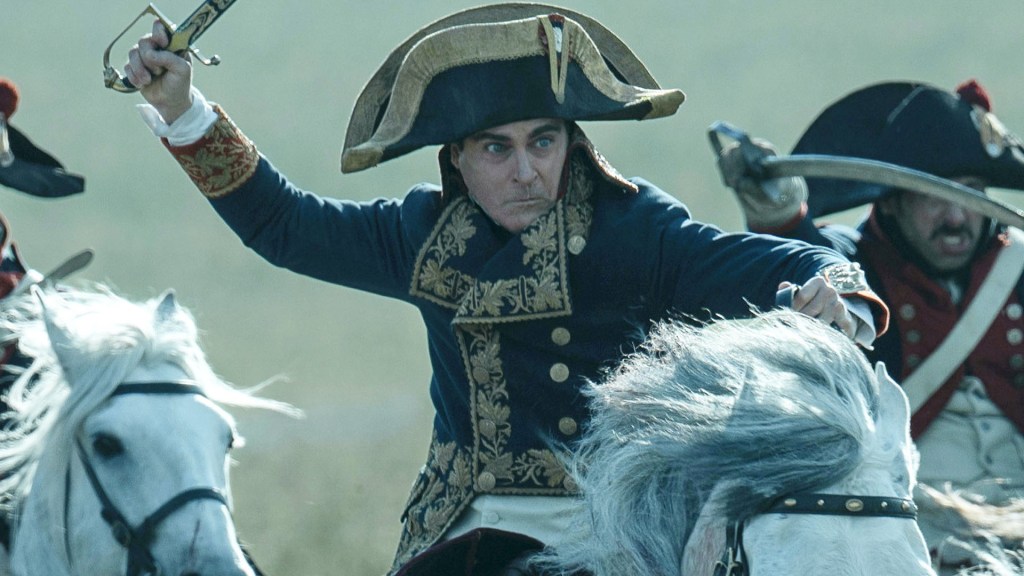
Luckily Ridley’s latest epic does strays away from some of this low hanging fruit to give us an entertaining romp through France’s history that shows us just what a little weirdo this Uber-powerful ruler was. His tale is complete with impressive battle sequences that maintain Ridley’s signature sense of scope and manage to blend both practical and digital elements rather seamlessly to always give these scenes a sense of reality. If you’re worried about this sounding a bit too familiar to historical biopics’ past, that’s because it kind of is. Ridley is operating on a level that directors with twice the budget struggle to achieve, but you aren’t going to find too much uniqueness in how the narrative is structured or how the story is presented. It’s still a damn fine film regardless, but it does lack a worthwhile identity that does keep this film from being as memorable as it could be.
Joaquin Phoenix is one of my favorite working actors, who manages to bring an off kilter weirdness to many of his best roles, yet still always manages to nail that human element that makes these out there and often alienated characters still connect with us. But it looks like 2023 is the year of weird sex freaks with mommy issues, because not only is that what Phoenix portrayed in Ari Aster’s Beau is Afraid, but in Napoleon as well. Phoenix’s take on the master general turned ruler is a lot of fun, portraying a man with a consistently high opinion of himself that’s used to shield his apparent insecurities. For how great of a man Napoleon is portrayed as, he still has moments of self-doubt and even incompetence that make him a great, flawed protagonist. Phoenix does a tremendous job at capturing a character with the gravitas of a god amongst men that is at the same time off-putting and occasionally pathetic. One only needs to look towards his relationship with Josephine, portrayed by Vanessa Kirby. He holds indomitable power over her yet often finds himself at her mercy, being unable to ever truly control her despite possessing the diplomatic tools to do so. This gives the two lovers a complicated dynamic, where neither one ever truly manages to get the upper hand on one another, mostly because the genuine friendship and respect for one another won’t allow it. They aren’t trying to manipulate one another as much as they’re trying to find ways to maintain happiness for the both of them. It’s a pretty interesting dynamic that I don’t think ever really becomes as introspective as it could have been, particularly for Josephine, as at times it does feel a tad too familiar to the power couple archetype without really getting all that meaty. Still Phoenix is great as always, and funny too. He’s at his best when he’s being super childish and petty, throwing food and yelling about boats.
The action set pieces are often the highlight of the film, filled with impressive scale, a multitude of extras, and some appropriately shocking gore. From the pyramids to Waterloo, these battles capture the horrific majesty of war in a way that never feels too over the top or understated. These often bombastic moments capture a great sense of scope that heightens the gravity of each, yet always manages to feel authentic rather than a pre-rendered cutscene populated by rubbery, faceless figures. While scenes of this magnitude are certainly a treat, they are still rather straightforward and lack memorability, which is an issue I’ve had with the rest of the film as well.
Everything is played pretty one dimensional for the most part despite its decent amount of entertainment value. At times it can really feel like a Wikipedia article brought to screen, only occasionally being broken up by a scene steal from Phoenix or the aforementioned battle scenes. While I have high praises for Phoenix’s performance, the character of Napoleon isn’t given a ton of material to really flesh the character out and dig deeper into their motivations and psyche. His life is often subjected to a “best of” style of storytelling, with several of these key, significant moments making very little impact on the character himself. The romance between him and Josephine is certainly the most intriguing part of the story for me, especially with how it ties into that superb final shot, but even that at times feels underdeveloped and yearning for a more dissective look. The film could have honestly benefitted from making the narrative more focused around their relationship rather than the somewhat generic trek through Napoleon’s rise and fall.

This basic narrative structure could have been a bit more tolerable if there was really any sense of character or uniqueness to the presentation. For how great a director Scott is, at times he really just moves from moment to moment in the most uninteresting way, with these big moments feeling like basic retellings rather than an artistic adaptation. The muted, gray color palette often did very little for me aesthetically, feeling too similar to other European historical films. I also never really felt like the large-scale battle scenes properly illustrated Napoleon’s tactical prowess in a way that really felt original or interesting. I’ve already said I adore the sense of scope in these scenes, but I never felt there was any deeper reason to them outside of the fact that they needed to happen to move the plot along.
Finally I guess I should address the historical inaccuracies presented here from things like how the battles actually played out to Napoleon’s overall impact and reputation in France, to which Ridley Scott responded with:

There’s definitely some things worth being critical about, but I also kind of saw it as Napoleon telling the story, rather the story being presented in an unbiased, hands-off way. This is further reinforced at the end of the film when Napoleon is writing his memoirs, shaping his story in the way he sees fit, truthful or not. I do think this could have been presented better overall in the narrative, but that’s my takeaway from it and it doesn’t necessarily bother me. As for the overall lack of attempt to have anyone even try to speak in a French accent, I guess that’s just the style Scott wants to go for. It’s fine and whatever, but it does get distracting when you have Phoenix and other side characters talking in completely different accents when they’re all supposed to be from the same country. All I’m asking is for a little consistency.
Despite this being a very straightforward and at times admittedly bland interpretation of France’s most prominent ruler, I still gotta respect the level of craftsmanship on display here. It’s big, it’s loud and it’s streamlined in a way that will make it easy for most moviegoers to get into. Phoenix is still one of the best actors alive, with his worm of a performance being an absolute delight to watch. Even with the expert attention to technical detail, I do wish this had more of a voice than what we got. It’s a film your dads and uncles are sure to get a kick out of, watching half awake from their recliners with motion smoothing set to ON on the television. Honestly, that’s the life I aspire to have one day.
Rating

The Bonaparte

As Orson Welles once said: “aaaAAahhhAhhh the FRENCH!”.
They’ve given us many wonderful things such as blood transfusions, the sewing machine, and even the first film camera. For a cocktail named the Bonaparte I wanted to instill a bit of that famous French classiness into a simple, three ingredient cocktail. The blend of gin, sweet vermouth and lilet blanc makes this a bit of a cross between a Vesper martini and a Perfect Manhattan, offering a nice balance of dry and sweet alongside the predominant botanicals of the gin. While short in stature it does pack quite a wallop, and shouldn’t be underestimated. Someone should have told the Austians that.
Ingredients
- 1/2oz sweet vermouth
- 1/2oz Lillet Blanc
- 1.5oz gin
- Garnish: orange peel
Instructions
- Add all ingredients to a mixing glass with ice and stir to chill.
- Strain into a chilled coup glass.
- Express the oils of an orange peel on top of the cocktail.
 The Martini Shot
One thought on “Napoleon – REVIEW & COCKTAIL”