

We have had Godzilla stomping across our screens for nearly 70 years now, and it doesn’t seem like that desire is slowing anytime soon. Since his humble, rubbery beginnings in 1954, the King of the Monsters has appeared in 38 films, with a new addition to Legendary Pictures’ Monsterverse series coming next year. But today we’re looking at Gojira’s home of Japan, more specifically, Toho Pictures, the studio that birthed this big bad lizard into existence. Toho has given us many different iterations of Godzilla, ranging from lovable savior of the Earth to grim reminder of humanity’s sin against itself. The latter is usually what I enjoy the most. Don’t get me wrong, I love a good monster mash with 50 different beasts battering the piss out of one another, but I think Godzilla is at his best when he’s properly embodying the devastating horrors of nuclear war. Every now and then Godzilla just needs a decent recent. You know, cut the expanded lore, cut the extra monsters, and just make it about Godzilla versus man, really lean into the post-war Japan hysteria that birthed the character in the first place. Godzilla Minus One does just this, and while the fundamental core of the film is everything you might expect, I would wager that in the 70 years we’ve had Godzilla, it has never been done better than it is here.
Minus One takes everything I know and love about the franchise and builds upon it in the most emotionally effective way the series has ever done. The heart of the story lies with the film’s human characters, whose journeys and trials are more captivating and engrossing than any Godzilla film I’ve seen before. No longer are they just filler in between a monster’s rampage, but an actually compelling ensemble that you can form a real emotional attachment to. Yet at the same time the film does deliver on impressive monster moments, which are shown in such an effective way that really sells the death and destruction of each scene. Mix these elements with incredibly insightful commentary on nuclear war, the failure of our governments, and the power of community, and you’ve got, dare I say, the best Godzilla film ever made.
Set near the end of World War II, a kamikaze pilot named Kōichi Shikishima abandons his post and returns to his destroyed home filled with shame and PTSD after an encounter with a pre-radiated Godzilla leaves many of his comrades dead. After forming a partnership with a woman named Noriko who adopted an orphaned baby named Akiko, Koichi begins to realize that his personal war isn’t over, as Godzilla re-emerges and begins to destroy Japan. From there the race is on for Koichi and his fellow countrymen to devise a way to stop Godzilla before he can eradicate their country they’ve struggled to rebuild since the end of the war.
Like I said earlier, you usually don’t give much of a damn about the human characters in these films. They’re kind of just there because Godzilla can’t exactly carry a film on his own with his mute self, and you really need a more personal connection to make any of the destruction he causes matter. Most Godzilla films include these characters as a requirement, but in Minus One the story is really about them, not Godzilla. It works incredibly well, due in part to a great story of redemption and rebirth, along with characters worth getting emotionally invested in. Koichi is a super interesting character, someone who really embodies survivors’ guilt and post-war trauma. He personally feels that if he had done more during his initial run in with Godzilla, he could have saved his friends, his family and the rest of his country. The fact that he’s also a kamikaze pilot is such a great parallel as well, as that role is seen as the ultimate sacrifice to his people and something he couldn’t find the strength to do. At least that’s what he’s convinced himself to believe, as the film makes it very apparent that many civilians and soldiers were quite critical of the Japanese government’s careless handling of their troops’ lives when signs of the war ending were very apparent. Despite these inner demons, Koichi still manages to find happiness in community, both with Noriko, a woman he forms a domestic partnership with, and the ragtag group of men he works with as minesweepers. All of these people are survivors of war in some way, which makes their comradery not only believable but quite engaging. With the world and even their own government refusing to help, they take it upon themselves to band together and use their skills and background to devise a plan to stop Godzilla. And might I add, this is one of the more interesting plans I’ve seen in these films. It’s not just some big, bombastic sci-fi weapon, but a plan based around believable science that actually adds more tension to the climax. It’s these super effective human elements that elevate this film beyond just a good Godzilla movie, but a straight up good movie.

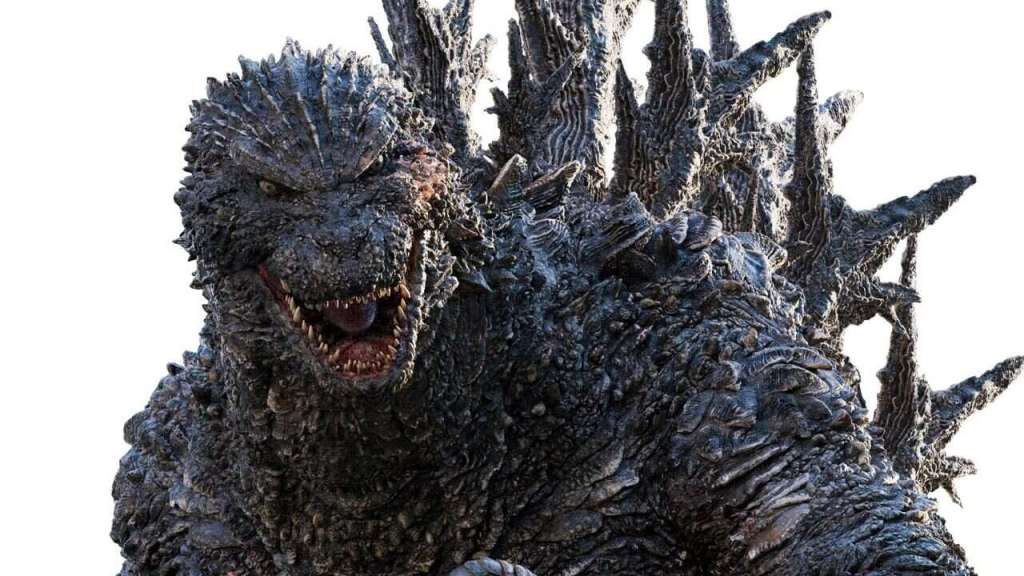
The titular monster is no less scary even without the full attention of the plot being on him. The film is a tad sparse with him at times which does lead to some slower pacing around the 2nd act, but when he is on screen, he’s absolutely devastating. He’s completely computer generated which isn’t new to the franchise, though his appearance is a lot closer to the current American adaptation of Godzilla rather than the previous pillar of death we saw in Shin Godzilla. While this adaptation feels fairly familiar, there are some tiny bits of uniqueness to him that I think really works. This includes his dorsal spikes lighting up and protruding as he charges up his atomic breath, and even the little detail that Godzilla literally burns his face every time he uses it because of how powerful it is. Speaking of the atomic breath, like I said before in the cocktail portion, this is probably the coolest and scariest incarnation of the blast I’ve ever seen. It feels full-on nuclear, blasting everything around it away before sucking everything inward like a black hole. The scenes of Godzilla’s rampage don’t always properly illustrate the scope of Godzilla’s size in my opinion, but it does give a tremendous ground-eye view of the chaos he causes from a human point of view. This makes the large-scale destruction feel a bit more intimate, which I think makes these scenes of hundreds of thousands people dying all the more impactful.
The metaphorical embodiment that is Godzilla has never exactly been subtle, and here it’s no different. A nigh unstoppable creature, birthed by man’s unquenchable thirst for power and control that lays waste to the innocent. While most films that feature Godzilla as the antagonist usually display some type of comradery between those trying to survive and stop the creature, Minus One’s climax is perhaps the most riveting. It no longer devolves into a large-scale military operation, but the last ditch effort of neighbors, friends and family who realize their own country has left them to die. Not only is this effective because of the real-life parallels it draws upon, but also because of how deeply personal it can all feel. For what feels like a first time ever for the series, the people who suffer the most are given the power and opportunity to fight back, and not through some convenient mystical or alien element, but real, genuine human ingenuity. In case you haven’t caught on, this is without a doubt the most human Godzilla film out there, and it’s absolutely what this franchise needed.

There’s really not much here for me to be critical about. The pacing can grind to a trudge at times, but there’s enough impressive elements working around it to make this forgivable. I guess the origins of Godzilla are a little lazy. Like our main character runs into him on an island before he gets all radiated and some guy is just like “oh yeah, that’s just Godzilla”. Honestly it’s kind of funny how dumb it is. And sure the special effects can sometimes be a bit mixed, but it’s hardly ever noticeable, and when you realize this was made for only $15 million, it just makes the entire final product all the more impressive. Plus, there’s plenty of nods and winks to the older films, along with the classic Godzilla theme song, which I don’t think has ever been as impactfully utilized as it is here.
Toting the best human story in the entire franchise, Godzilla Minus One is the pinnacle of the series, while also containing stellar effects that truly illustrate the almighty wrath of the King of the Monsters. If you’re more of a fan of the monster vs. monster brawls of the series’ past, you may find yourself a bit disappointed, but this is one of the very few times where the series has transcended the genre and has become an overall stellar movie. That’s why I feel very confident in saying this is one of my favorite films of the year, and the best Godzilla film of all time.
Rating

Atomic Breath

Godzilla’s atomic breath is one of the king of monster’s most recognizable tools, right alongside his WMD heart and his sliding tail drop kick. Now, last time I reviewed a Godzilla movie the cocktail had the big lizard himself in mind, but this time I want to focus on his blue fire breath that has perhaps never been as devastating as it is in Minus One. This tall blue beam packs the radioactive heat you would expect thanks to a little habanero, as well as a cooling bite thanks to a little mint. Take a deep breath and flex those dorsal spikes.
Ingredients
- 2oz soju
- 1/2oz lychee liqueur
- 1/2oz blue curacao
- 3oz coconut water
- 1/2oz lime juice
- 8 mint leaves
- 1/4 habenero pepper (1/2 for extra spice)
- Garnish: Mint sprig
Instructions
- Add ingredients to a shaker and shake with ice.
- Double strain over ice in a tall glass.
- Garnish with mint sprig.
 The Martini Shot
One thought on “Godzilla Minus One – REVIEW & COCKTAIL”