

How were you first introduced to anime? Maybe you were like me and caught dubbed and heavily edited episodes on things like 4Kids or Toonami. Maybe your path was a bit more unconventional. Maybe your first exposure was through Dragon Ball AMVs set to Linkin Park. Or maybe your introduction didn’t revolve around spikey hair protagonists that have to save the universe through a game of dominoes or whatever the f*ck. Maybe you were introduced through wondrously fantastical films of Studio Ghibli.
Founded in 1985 by filmmakers Hayao Miyazaki, Toshio Suzuki and Isao Takahata, the animation studio’s catalog is chock full of some of the most beautiful and whimsical films the world of animation has ever seen and Earwig and the Witch. Known for rich watercolor landscapes, fantastical characters, and depressing reflections of wartime, Studio Ghibli was a lot of people’s first introduction to animation outside of the US. From Spirited Away, to Howl’s Moving Castle, to funny pig pilot movie, a lot of these films’ existences are owed to filmmaker Hayao Miyazaki, who many people credit as one of the most important figures in animation history. 2013 was touted as Miyazaki’s final rodeo, releasing The Wind Rises, which was meant to be his final film. Even with Miyazaki in retirement, Studio Ghibli still continued to release films from other directors, including Goro Miyazaki, Hayao’s son. Yet none of these films really managed to garner much attention, with the studio reaching its lowest point with the release of the aformentioned Earwig and the Witch.
Seemingly not content with where the studio was going, the master rose from his throne and returned for one last movie. Allegedly. This is his 2nd retirement film and there’s already talks about Hayao returning for another one after this. Gotta love the drive.

The Boy and the Heron is Hayao’s return to animation after 10 years, and while all of his films often feel deeply personal, this one does in a very different way. The film feels like a self-reflection on Miyazaki and his work, pulling out many of his calling cards for what does feel like one last hurrah to storytelling. The film is unsurprisingly gorgeous, containing some of the all-around best visuals and animation you’ll see this year. Where the film might lose some people is with its rather abstract story, which could leave you scratching your head trying to understand the bigger picture of it all. I’m not going to lie, that’s kind of the camp I’m in. The narrative can often feel cobbled together and doesn’t develop and flow as seamlessly as his past work. But even with these concerns, I can’t tell you how special it feels to get to experience a new Miyazaki film, and not from Goro this time.
Set in World War 2 Japan, we follow a young boy named Mahito who moves to the countryside with his father after his mother dies in a hospital fire. His father remarries his wife’s younger sister, Natsuko, who lives in a family estate along with several elderly maids. While struggling to adjust to his new life, Mahito grows pestered by a taunting gray heron. As Mahito engages with the bird further, he suddenly finds himself pulled into a wondrous but crumbling world, where time and reality converge in bizarre ways.
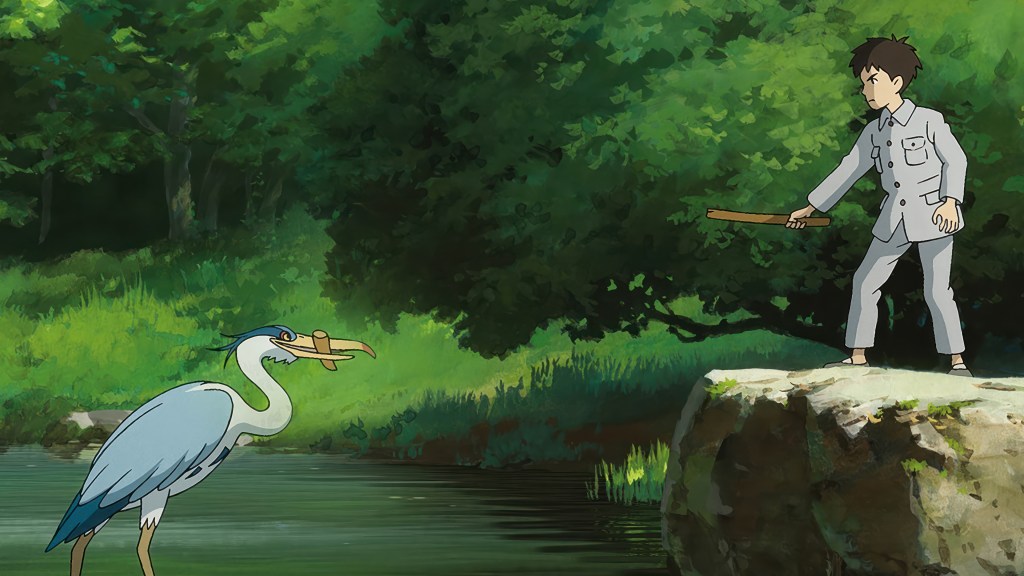
So before going forward I feel like I should mention that I watched the dubbed version of the film rather than the subtitled version. This isn’t something I would normally do, but sweet Jesus, with a cast like this, how could I possibly pass that up. Studio Ghibli isn’t a stranger to landing some big names for their films; just look at Christian Bale and Billy Crystal in Howl’s Moving Castle. Here you’ve got Florence Pugh as the no-nonsense fisherman Kiriko, Christian Bale as the well-meaning but absent minded father Shoichi, Dave Bautista as the hot-headed Parakeet King, and even Willem DaFoe as a dying pelican for a full minute. But the biggest voice role I want to talk about here, mostly because of how batshit weird it is, is Robert Pattinson as the Heron. Genuinely and unequivocally unrecognizable. If I hadn’t known this was Pattinson before going into this film, I could not have guessed. Pattinson is such a grimy little troll of a character, being both snarky and pathetic when it’s called for. He is fully losing himself in this character, and was easily the highlight of the film whenever he gets to be on screen.
But let’s talk about our main character, Mahito. He’s got a lot going on; dead mother, new step-mother, talking birds, going full isekai in a nonsensical world. I remember when I went through the same thing at his age. Like in many films of this kind, Mahito is the conduit to which we experience this weird new world. But I hate to say it, he might be one of the more boring ones. Sure, a lot of interesting stuff is happening to him, but this doesn’t lead to a ton of interesting development as a character. His motives and views on his relationships just seem to change on a whim, without any clear indication as to why. He feels very similar to how he was at the beginning of the film at the end as well, not really changing on an emotional level and lacking any real substantial growth. Really, he just hardly reacts to a lot of the things he’s presented with, and while I do think this is used to show him as someone who’s good of heart and mature, I just don’t think this gets illustrated all that well.
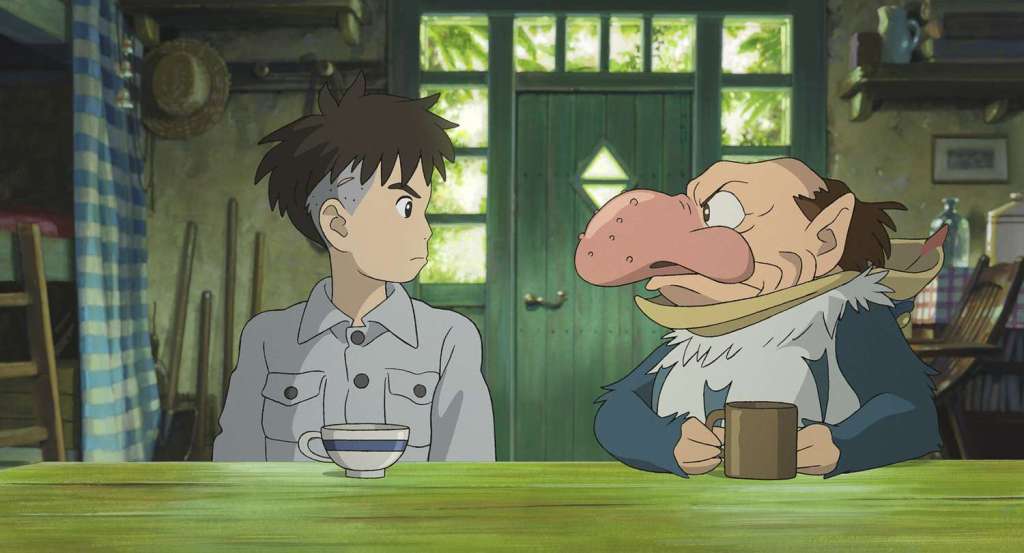
I also found the story to feel a little lackluster at times as well. Sure, with these Ghibli films sometimes you have to take the world presented for what it is and just roll with it, which isn’t necessarily a bad thing, even here. The film is all about discovery, both for ourselves and our main character. The world is weird and imaginative, and even though I feel like it doesn’t tie into the central narrative as strongly as I’d hoped, the discovery aspect is still super rewarding. Each new local or new creature always feels welcome, and you can find yourself really getting sucked into it and accept it all. But I do feel as though some of these moments don’t reach a satisfying payoff sometimes. This isn’t a case of me wishing things would be explained more, but I would like to feel like they made an emotional impact on me. It’s hard to be specific about these moments while staying spoiler free, but at times I did find moments and characters to feel disconnected from what the story was trying to accomplish, at least in my eyes. Mahito eventually meets a character who you come to find shares a very important connection to him, but the film refrains from any satisfying emotional moments between the two, and once the reveal of who this character really is comes to light, it makes little to no impact on the characters or the story. This is kind of why I wanted to bring up the fact that I saw the dubbed version, because maybe these moments were ultimately lost in the translation, and to be sure I’m definitely going to have to visit the original version at some point.
I’ve been sounding really negative towards the film, but let me be clear, I do not think this is a bad movie. How could it be with the visual splendor it provides. Some may find this to feel very similar to Miyazaki’s past work, but I don’t really see that as a negative. Like I said, you’ll be hard pressed to find a more beautiful animated film this year. Everything from the landscapes to the silly little creature designs are top notch artistry, feeling familiar in aesthetic yet unique enough to stand on its own. And even though I had a lot to say on the perceived lack of coherency between the themes and the plot, I still find what this film was trying to engage in to be beautiful. There’s a lot of talk on mortality, clinging to the past, and the creation and importance of art. It feels very clear that this is Hayao holding a mirror up to himself and looking upon his life’s work as he nears the end of it. Some could see this post-retirement return to be Miyazaki struggling to accept the inevitable, and I think he’s well aware of that. There will always be that drive in us that makes us chase a feeling or emotion we had in the past, only to find those memories to be an often unstable tower of blocks. We can keep trying to add onto those memories, but eventually everything is going to come tumbling down. It’s a jagged pill to swallow, but The Boy and the Heron is Miyazaki’s reckoning in that. And you don’t need a legacy like his to relate to that. It could be a person or a specific time in your life that now only exists in your mind, one that you find hard to accept or let go of. It’s the most fitting thematic swan song for an artisan like Miyazaki, and my main disappointment stems from the fact that the story itself doesn’t really serve those ideas as well as it should. It is very true to its dreamlike setting in that regard and it serves as a suitable enough conduit to present these ideas to us, but this doesn’t lead to the most complete or compelling final product.
Even if I don’t think this is one of my favorites from Miyazaki, it still manages to be leagues better than most films I’ve seen this year. Hayao hasn’t lost that touch of wonderment that makes his films such a joy to watch, cohesive plot or not. Watching the film is undeniably an experience, and one that is going to affect people in different ways. If you haven’t seen the film, please do not let my critiques deter you from seeing it. This is a movie meant to be discussed; it won’t always hold your hand or be straight with you, which are some of my favorite movies to watch. I’m already looking forward to my next viewing, and who knows, maybe over time I’ll find it growing on me a bit more. If this really is Hayao Miyazaki’s final film, I can’t comfortably say I would be disappointed. He got to say what he wanted to say, and for the past few decades, he has been one of the finest storytellers in the world of film. He’s more than earned his legacy, and hopefully he’s found the catharsis he was looking for. And who knows, maybe one day his son Goro will become a master storyteller just like him.
…eh
Rating

I Dream of Parakeets

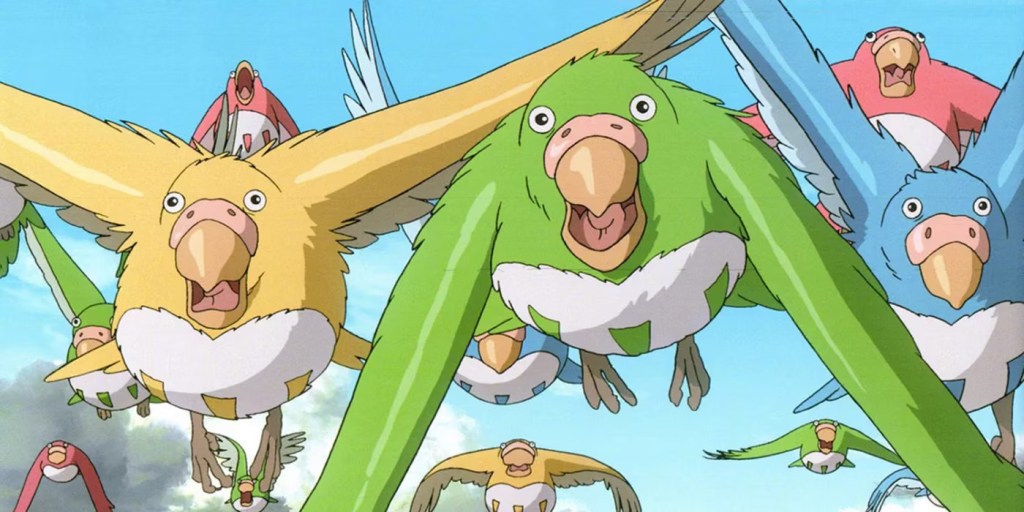
If there’s one thing you can expect from a Miyazaki film, it’s funny little creatures. This film actually has a few, like the warawara, little balloon guys who are unborn spirits that float to the surface world to become babies. But for this drink, I wanted to pay tribute to the goofy, man eating parakeets that try to hinder Mahito’s journey. The drink is slightly pink in color, while also being creamy and light to capture some of that dream-like aesthetic the world of the film offers. The unique balance of earthy, herbacious flavors, slight tartness and creamy texture give you an isekai experience with each sip. That’s right, I know amine terms.
Ingredients
- 1.5oz gin
- 1oz yuzu-flavored sake
- 3/4oz creme de violette
- 1/2oz lavender infused simple syrup
- 1/2oz Earl Grey tea
- 1 barspoon grenadine
- 1 egg white
- Garnish: edible flower
Instructions
- Add ingredients to a shaker and dry shake for about 20 seconds.
- Add ice to the shaker and shake to chill.
- Strain into chilled coup glass.
- Garnish with edible flower.
 The Martini Shot
One thought on “The Boy and the Heron – REVIEW & COCKTAIL”