

To preface, I am not the biggest Dune fan out there, speaking on the whole of the IP itself. I haven’t read any of the books, and while I enjoyed the 2021 film, I wasn’t as head over heels with it as everyone else seemed to be. To me, it felt a little hollow; impressive in scope and scale yet lacking the deeper emotional element that could elevate it into the next big cinematic experience. I liked it enough, but I wasn’t really sure how to feel about a sequel. I adore director Denis Villeneuve’s work, from Prisoners to Arrival to Enemy, so I knew I could trust him with delivering a solid film. Warner Brothers, on the other hand, I did not really trust. I have soured on WB over the past few years due in part to things like the Discovery merger, the fumbling of the DCEU, the skewering of their animation department, the pulling of several shows from their streaming services, making them conventionally impossible to watch, and most recently, the complete deletion of close to complete films for tax purposes. Artistry and love of the craft don’t seem to be too high on WB’s list of priorities as of late, so the fact that a bold, gargantuan film adapting a book series that many considered unadaptable. But here we are; it got made despite everything, but is it any good?
No.
It’s fantastic.
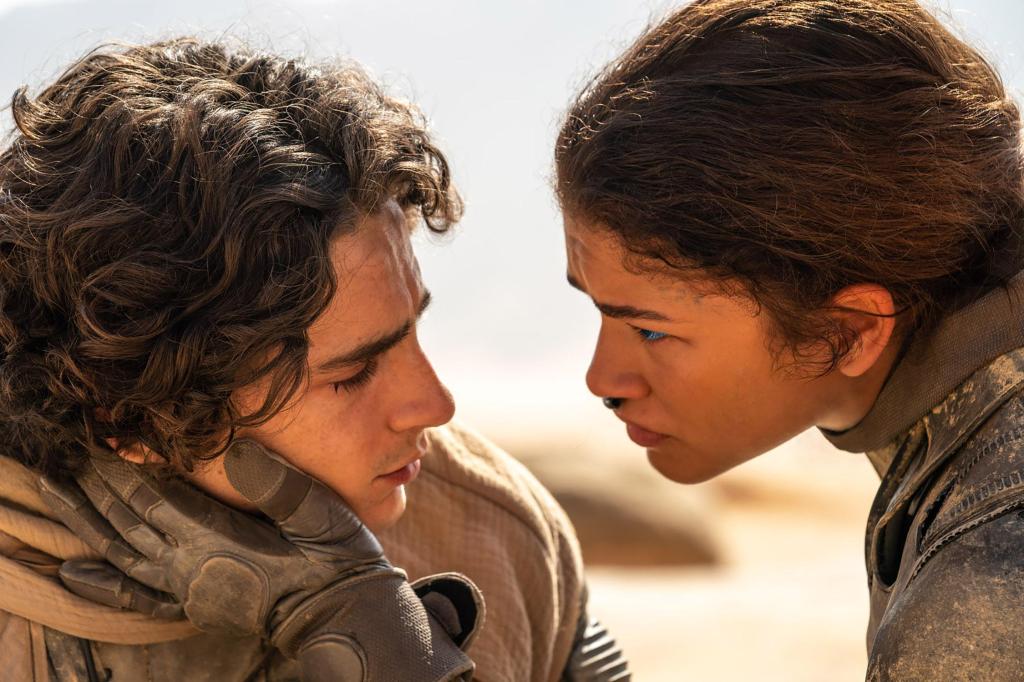
Dune: Part 2 has bounded past the first, building and developing on every problem I had with the first film, while accentuating everything about the first I loved. It’s a sci-fi epic unchained from its limitations, housing a visceral narrative that masterfully twists what we experienced in the prior film and challenges its dynamics and direction. The world building continues to be impressively enthralling, showcasing each locale with a striking and defined visual flair that only impresses the more you lay your eyes on it. The character work is fleshed out and given the necessary depth to further expand upon these performances in truly exciting ways. The entire thing is a technical marvel, never once buckling under the weight of its grandeur, feeling confident and fully realized. Seeing this in IMAX solidified I was witnessing something special; a cinematic achievement for one of the most uncertain times in modern film history. It’s such a complete package that I truly believe this has the potential to become one of sci-fi’s next biggest smash hits, and potentially one of the best sci-fi films in the last few decades.
Picking up right where Part 1 left off, we find Paul Atreides on the run after a plot to overthrow his family leaves his father dead and his empire in ruins. Taking a hesitant refuge with Arrakis’ native Fremen, seeds begin to be planted for Paul to become a messianic figure that will lead the Fremen to achieve independence on Arrakis. Yet the future seems dark, as the Harkonnen seek to wipe out the survivors of House Atreides, the Bene Gesserit attempt to keep a long-planned infiltration of the Empire on course, and a prophesized holy war begins to manifest at the hands of Paul himself.
One of my biggest complaints with the first Dune was that it felt like a lot of setup that never really reached a satisfying payoff by the end. We got hints of what would become of characters like Paul, his mother Jessica and Paul’s literal dream girl Chani, but were left with more promises than resolutions. Well consider those promises kept, because Part 2 does a phenomenal job at making these characters a lot more interesting and a lot more fulfilling. Paul at first seemed like that stereotypical “chosen one” archetype; destined at birth to accomplish things no one else can. Not always super exciting to say the least. Yet this time around Paul is beginning to ease his way into that role, at first reluctantly but eventually committing heavily to the bit. But Paul’s journey has a wrench thrown into it, as he begins to have visions of a holy war of which he’ll be responsible if he continues down this path. What I loved about his journey is that it doesn’t involve him trying to sidestep the inevitable, but his eventual accepting of it. Paul starts out as someone thrust into a position of power that truly wants to do the right thing, and by the end that’s still more or less the same, though the “right thing” becomes a little more gray, skewered by earworms proclaiming religious zealotry and thirsts for revenge. It’s a very compelling arc for a main protagonist to take, and I have to give the utmost props to Timothee Chalamet for making this character work. Chalamet is an actor I’ve known for years was good, but I was still waiting on that one, solidifying role that catapults him into megastardom. After several years, I truly believe this is it. Chalamet manifests the earnestness and the presence needed for this role tenfold, eliciting your compassion at one point, then commanding your attention in another. It’s a hell of a spectrum to work within, but Timothee absolutely nails it. I kind of already know where this character will end up, but I’m highly anticipating Timothee’s continued transformation going forward.
Chalemet isn’t the only one bringing the spice, as much like the first, this film is brimming with talent and impressive character work. Zendaya’s Chani has officially graduated from Chanel commercial model to an actual character. Chani is one of the few Fremen who is a nonbeliever when it comes to her people’s prophecy, seeing it as a construct of powerful figures created to control her people. Despite this, she eventually forms a romantic relationship with Paul, seeing him for who he truly is outside of the influence of his mother and followers. This is actually one of my few complaints about the film, being that I don’t really think Chani and Pauls romance is well developed. I think they become close way to quick, while not really establishing a clear emotional connection between the two. I think Zendaya and Chalamet do have the chemistry to salvage this, but it was something I wish could have had more build-up to. Despite this, Zendaya is a headstrong voice of reason whose role in the film actually differs from the book from what I understand, so like Paul, I’m super excited to see where she goes next.

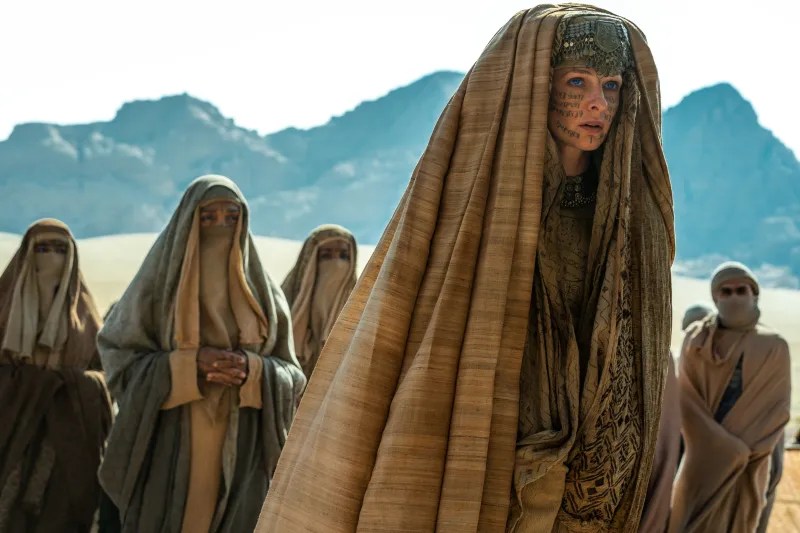
Rebecca Ferguson returns as Lady Jessica, who probably has one of the most striking developments out of all the characters. She takes on a role amongst the Fremen as Reverend Mother, a position usually held by someone actually from the tribe. Her insertion into this role heavily changes her, while also further expanding upon that underlying theme of colonization and infiltration of a society as a means to control it. This turn from protective mother to seemingly crazed plotter is honestly pretty unsettling, and Ferguson isn’t afraid to go there and get a little weird. Javier Bardem’s Stilgar is another interesting role. As a firm believer of the Lisan al Gaib, Stilgar is perhaps Paul’s most reliable asset in gathering believers. His fanaticism at first is honestly pretty comical, drawing big laughs from the audience, but as the plot thickens you begin to realize just how blind he is to what is happening, falling for a pre-constructed prophecy due to his devout drive to protect his people. Another standout despite his limited screen-time is Austin Butler as Feyd-Rautha, heir to House Harkonnen. We’re far enough removed from the impressive but memed to death performance of Elvis to see what a phenomenal actor Butler truly is. Like in Elvis, Butler is not only physically transformative, but vocally as well. This allows him to truly embody the deranged, sinister warrior Feyd-Rautha is. Serpentine in movement as well as viciousness, Butler utterly disappears in the role and obviously has a bright future ahead. And there’s so many more impactful supporting players, including Florence Pugh’s Princess Irulan, Stellan Skarsgard’s Baron Harkonnen, and Dave Bautista’s Rabban. Everyone has an important role to play, and it’s fantastic to see so many talented actors coming together to be a part of this modern day spectacle.
Not to beat the same dead horse everyone else has, but good God this is one of the best looking sci-fi films to date. Thanks to a mixture of practical and digital wizardry, every location feels believable and realized. Never once does the magic feel challenged. Locations are well rendered and structured, creating one of the greatest illusions of alien planets I’ve seen in a long while. Something that’s really been built upon since the first film is the use of color. I found the color palette for most of the first film to be pretty dull, but expected considering most of it takes place on a sand planet. However, the filmmakers have found a way to inject a substantial amount of color into scenes and locations to allow them to pop more without feeling too over stylized or oversaturated. The sandy landscape of Arakkis is often blinding during the day as the sun illuminates the sands, but as the sun sets we get much more warmer, orange tones, and once night comes the dunes radiate a deep, cool blue. This may sound like obvious ways to color a scene, but believe me, I’ve seen enough poorly lit scenes the past couple of years to believe everyone in the industry needs to be taking notes. Another striking use of color comes from Giedi Prime, the home of House Harkonnen. Because of the planet’s black sun, daytime is colored by striking uses of black and white, and the way it’s executed by seeing people move from the shade into the sun is super, super cool. There’s also instances of fireworks going off that take the appearance of exploding, black inkblots that coat the white sky, which is such a creative idea, and why the few scenes we get on this planet were amongst my favorites.

There are so many moments of astonishing technical achievement, where the lines between real and fake have never felt more blurred. Scenes involving the gargantuan sandworms are an obvious standout, appearing highly-detailed and well staged to the point where you don’t even question what you’re seeing. This comes from a commitment to integrate practical effects as much as humanly possible before relying on VFX. From what I understand it took months of throwing sand at Timothee’s face before finally adding the worm in post, and I gotta tell you, it pays off. Meanwhile the technology of this universe continues to be highly interesting. Many of the ships maintain a semi-organic appearance and movement, while harvesting machinery maintains a jagged, angular design to reflect the emphasis on industrialization that has overtaken Arrakis. Even little things like voice recording devices and tents have a lot of intentional detail behind them, which I really respect. And not to bring this up again, but holy shit, scenes are actually properly lit so that they can be both visible and grounded in reality. Villeneuve and team have achieved one of the most believable sci-fi worlds to date with just a $190 million dollar budget. You may be thinking that’s a lot of money, and you’re right, it is. But there’s soooo many films with much higher budgets that don’t come anywhere close to looking this good. That’s talent and care right there, and it outweighs money almost every single time. Finally, when the film wants to get bombastic, it delivers on this in droves. The action sequences are intense, highly thought-out, and incredibly satisfying thanks to a mixture of those aforementioned effects and highly effective, otherwordly sound design
It’s not just the visuals that help make the world feel fully realized, but also the attention to detail when it comes to fleshing out the culture of the Fremen and other groups. We get a lot more insight into their beliefs, customs, and ways of life, which helps make the world feel far more complete. This was something we only got glimpses of in the first film, which ultimately hindered my ability to form personal connections with many of the characters we’d meet. Yet here we find more insight into how and why these characters act the way they do, which makes the decisions they make along the way all the more effective. Everything from the individual to the collective is handled so well, really enveloping you in this world and creating a far more interesting cinematic experience.A big reason for this is because of how the narrative progresses, severely altering these characters and groups in such an enticing way. I made mention prior of themes of colonization, which is expanded upon significantly by how Paul and Jessica assimilate into the Fremen. Even if their intentions start off well-meaning, there’s still unseen manipulation at work that sets out to take advantage of the Fremens’ beliefs, constructing an artificial “savior” that will bring them and the rest of the galaxy to bloodshed. Where this film leaves off is incredible, leaving the ending just open enough to entice you to see what’s next, but also makes sure to bring the arcs of the characters presented in this film full circle. What a hell of a climax.

I couldn’t be happier when a film I had so-so expectations for blows me away. Dune Part 2 is a prime example of how to elevate a film in its sequel. It’s a tremendous achievement in sci-fi filmmaking, hosting some of the most stunning visuals and environments the genre has ever seen. The performances are knockouts, elevating their characters in complex, morally gray figures that manage to grip you in such impactful ways. It all culminates into a cinematic experience for the ages. Seriously, if you can see it in IMAX, go for it. Hell, if there’s a 4D showing that shakes the shit out of your seat, give that a try too. We may be standing on the precipice of something great; the next big blockbuster franchise similar to the MCU, Lord of the Rings, or Star Wars. Denis has all but solidified himself as one of the best and most reliable directors working today, and he’s earned this dream opportunity to make a movie he’s been wanting to ever since he was young. Legendary Pictures, you are doing Lisan al Gaib’s work by giving this the chance it deserves. And Warner Brothers, if you somehow find a way to fuck this trilogy up, I will leave David Zaslav to the desert drained of all his water.
Rating
Water of Life

The Water of Life is drunk by incoming Reverend Mothers, a high ranking position among the Fremen that Lady Jessica finds herself slotted into. Don’t let its electric blue sheen fool you; it’s a highly dangerous poison that will kill most men who drink it. Oh, and it’s worm piss. Piss from a worm. For this cocktail I wanted to tap into the middle eastern inspirations that influenced the design of the Fremen, and to do that we’re going to be using a popular Middle Eastern anise-flavored liqueur called arak, as well as a blend of spices to give this a bit of a kick. It’s quite the unique cocktail, one that may leave you seeing the future if you’re not careful. Just know you can’t blame me for any holy wars you may enact.
Ingredients
- 3/4oz arak
- 3/4ozoz blue curacao
- 1oz mezcal
- 3/4oz baharat simple syrup
- 1/2oz lemon juice
- 1oz coconut water
Baharat Simple Syrup Recipe
- 2tbsp cumin
- 1tbsp black pepper
- 1tbsp coriander
- 1tbsp paprika
- 1tsp cardamon
- 1/2tsp cloves
- 1/2tsp nutmeg
- 1 cup sugar
- 1 cup water
Instructions
- Add ingredients to a shaker and shake with ice.
- Strain into cocktail glass.
 The Martini Shot
2 thoughts on “Dune 2 – REVIEW & COCKTAIL”