

Oh boy, after nearly 50 years of development, millions of bottles of wine sold, the firing of the visual effects and art department, sexual misconduct allegations, and one trailer immediately pulled because of AI generated quotes, Francis Ford Copalla’s swan song has graced our screens against our will. The legendary director of The Godfather, Apocalypse Now and Bram Stoker’s Dracula has poured over $120 million of his own money into this passion project so he could make the film he wanted to make without any studio interference, and boy did he make a movie. Megalopolis has been called many things; confusing, inane, messy, off-the-rails, inspiring, imaginative, provocative, and personal. And I’m here to say…yeah, it’s all of that.
Megalopolis is postmodernism on ketamine; a gaudy, transcendent reflection on the end of empires and how prosperity can be brought before it. It takes Hank Aaron level swings to illustrate this point, some that are fun and inventive, and others that are half baked and conflicting. Somehow it manages to feel both egoless yet self-serving, sincere yet shallow, beautiful yet ugly. It is a confounding film that teeters on the edges of ruin and triumph and is unlike anything I’ve seen and possibly will see again. So, did I like it or did I hate it? Yes.
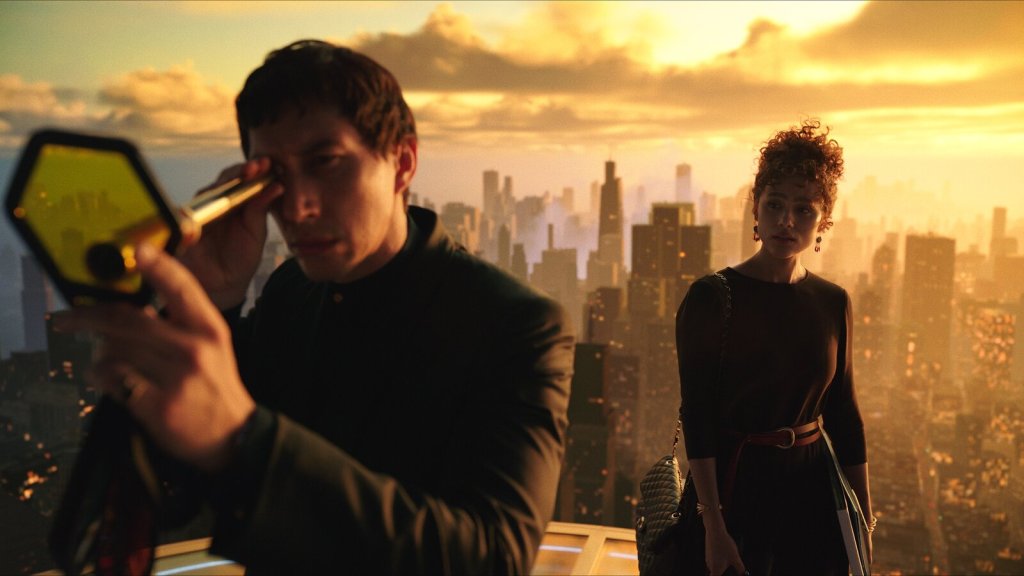
Set in an alternate present-day United States, brilliant inventor and architect Caesar Catilina works to build his magnum opus, a eutopic society called Megalopolis. He faces push back from the mayor and other powerful figures, but when teamed with the mayor’s daughter Julia, Caesar fights tooth and nail to build the future that is needed before the present collapses underneath them.
Where to even begin with this film? The performances at times feel incredibly disjointed, as if they were characters pulled from different films. Adam Driver, portraying genius Caesar, is fully committed to the absurdity of this film, but that does lead to genuine earnesty that shines through the nonsense about stopping time and creating Gods with our minds. At times he does just come off as a quote machine, spouting Shakespear and philosophical ramblings that Coppola probably thought were smart sounding. But other times he’s an envoy of progress, one that doesn’t just come from abstract, futuristic architecture, but a drive to discuss the world we live in so we can avoid its self-destruction. It honestly feels like Neil Breen’s kind of character; a tortured visionary destined to save the world with no real substantial flaws or arc to experience. Driver gives it his all, and while it doesn’t lead to a perfect performance, a lesser actor couldn’t have made it work as well as he did.

The rest of the cast is a bit mixed. I thoroughly enjoyed Giancarlo Esposito getting to be something other than a Gus clone as Mayor Cicero, and Jon Voight as aging banking trillionaire Hamilton Crassus III. Then there’s those less consistent performances from those of Aubrey Plaza and Shia LaBeouf, two solid actors who I think are either misdirected or not directed enough. Most parties involved do what they can with the script they’re given, which is a hodgepodge of grandiose lunacy that can actually be quite humorous when it wants to be, and the same thing when it doesn’t want to be. It isn’t completely unaware of itself, it’s portrayal of a Virgin Mary-like popstar getting outed for being promiscuous and then going through an edgy makeover is pretty hysterical. Those core ideas of empires, societies and the role of art in all of it do manage to shine through in genuinely touching ways, you just have to shift through go-nowhere side plots and mind-numbing, coked-out sequences to get there.
Like the rest of the film, the visuals are so inconsistent, probably due in part to that VFX team firing. The film contains genuinely immersive imagery, gold and glittery colors, and imaginative world building that pulls from works like Metropolis. But on the other hand, a lot of visuals look tacky, unfinished and unrealized. At times the world feels as if it exists in a grounded reality on recognizable city streets, but then in the same breath, locations will look overly-fantastical while the humans that roam about them feel disconnected from their habitats. It’s incredibly inconsistent in both quality and utilization, and I could understand and maybe forgive one or the other, but not really both.

After all this, I’m still unsure of where my heart falls with this. On the one hand, Megalopolis reads as a messy shotgun of ideas by a director that let his ambitions get the better of him, failing to harness the storytelling prowess to succeed with a tale like this. On the other hand, it’s a purposefully outlandish and otherworldly creation that goes big with its presentations to craft a modern odyssey that doesn’t want to be viewed in a straightforward manner. One mustn’t overlook that little “A Fable” subtitle. But ignoring all that, I think it’s the context in which this film was created that sticks with me the most. Coppola is rightfully regarded as one of the greatest of all time, and yet in this new world of short attention spans and easily consumable media, he struggles to make the art he wants to make. Decades ago he was disillusioned by the studio system and fought with his own money to get this film made, and now it comes out in a time where it really feels like we are nearing the end of an empire. Now, whether that empire is as broad as society or as contained as the film industry is up to you, but we’re all feeling it in some way. This is Copolla’s cry for love, for art, for earnest creation. This is wholly his film, warts and all. You rarely see an act of expression on this level nowadays, and while I can’t say I exactly “loved” Megalopolis, I do respect the hell out of the tenacity. It’s not the easiest watch and I think the average audience goers will hate it, but if you’re looking for a huge leap of faith, I think it’s worth taking the plunge. After all, when we leap into the unknown, we prove that we are free.
RATING
MEGALON

No, this isn’t my favorite Godzilla monster, this is the key to unlocking the future we need. It can build structures, look into the past, and even fix a hole in your head! Well, not really, but it can give you a good time. The mixture of bubbly body and molasses and spiced flavor profiles pair surprisingly well, with just a hint of tartness underneath it all. And unlike Caesar’s Megalon, this one doesn’t have traces of a dead wife in it!
INGREDIENTS
- 2oz bourbon whiskey
- 1/2oz elderflower liqueur
- 1/2oz lemon juice
- 3/4oz maple syrup
- 1/4oz mezcal
- 1/2 barspoon edible gold dust
- Top: champagne
INSTRUCTIONS
- Add ingredients (except the champagne) to a shaker and shake with ice.
- Strain into chilled champagne flute (or other tall glass).
- Top with champagne.
 The Martini Shot