
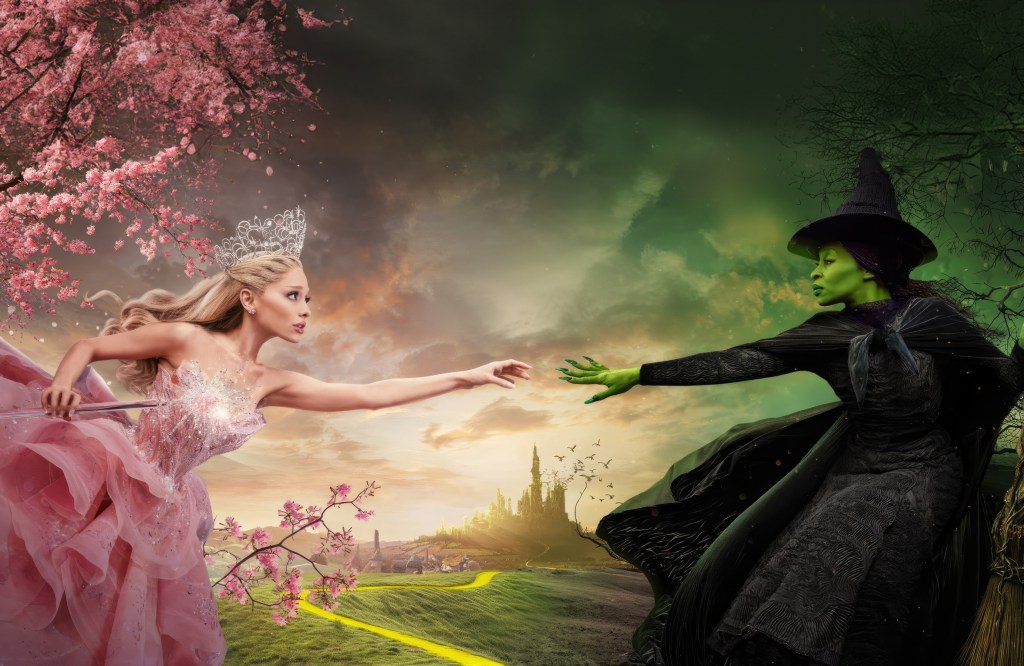
Musicals often feel like one of the most divisive film genres out there. The constant belting of your narrative and feelings through song can be seen as impassioned for some and grating for others. You know, I’m kind of in the middle there. Sometimes the only way to fully encapsulate the magnitude of the emotions and setting is through a grand musical number with aggressively detailed choreography. Films like La La Land, Chicago, and Moulin Rouge all succeed in this realm for me because everything feels appropriate and significant.
But 2024 has not really captivated me with its musical offerings so far. Mean Girls didn’t really nail the jump from stage to screen, and Emilia Perez’s existence as a musical never really felt justified outside of an apparent need to be the most unique film of the year. So that brings us to Wicked, the adaptation of the acclaimed theater production, which I will say, out of the three musicals I’ve seen this year, I do think it’s the best, but is it good?

Wicked’s successes lie in its performances, from its lead stars to even its background roles tearing the dancefloor up. Cynthia Erivo and Ariana Grande have the kind of enemies-to-friends chemistry that makes their journey quite entertaining to watch. When the musical moments hit, they can really hit, even though the whole soundtrack isn’t a complete collection of bangers. But with all these positives, it’s a shame that my biggest issues come from the film’s presentation, from its questionable visual style to its thinly stretched narrative. I’ll be the first to admit it isn’t the emerald-coated train crash I might have been expecting, but I do feel confident that with all the visually expressive filmmaking out there, we do have the right to expect a little bit more.
So Wicked tells the tale of the Wicked Witch of the West before she became a cackling, easily meltable villainess. She was once an outcast girl named Elphaba, whose untapped magical powers earns her a seat at Shiz University. While there, she becomes unwilling roommates with spoiled airhead Galinda, who has great dreams of becoming a sorcerer. The two eventually form a budding friendship as Elphaba works her way to a meeting with the great Wizard of Oz, while also becoming aware of a huge conspiracy that boils underneath the magical world.

As I said before, the performances absolutely nail their roles, most obviously with Erivo and Grande. Erivo undeniably has one of the most powerful voices out there right now, which absolutely pays off as Elphaba rises from being reserved and understated to an undeniable force to be reckoned with. From an acting standpoint, Erivo does an admirable job, though I did find her characterization to be a tad underdeveloped. It’s easy to want to see her succeed thanks to the cartoonish malice and lepper-like reactions she receives, but I didn’t feel anything deeper than that. Her wants and goals don’t always feel entirely realized, while her inner turmoil over her perceived role in her mother’s death never really comes to the forefront in how she acts or develops. You would think that a part one with a runtime that matches the entire length of the original stage production would give the film more time for character development, but really, it just gives more room to dance around the idea. Sometimes a shorter amount of time is better, because you have to get right to the point and not beat around the bush.
Then there’s Grande, who I admittedly had the most concerns about going into this. Sure she can sing, but it’s been a minute since I’ve seen her act. Luckily, the role of Galinda is the absolute perfect role for her. Bubbly and ditzy, yet possessing the volume for change, Grande shines through a character that could have been incredibly one note, but actually receives the most character development out of the two. I do think a little more could have been given, considering she eventually turns on and rejects her friend later down the line. The rumblings of this are shown in the film’s climax, but their severance ended up being purely physical while I think there could have been a slight dash of methodical thrown in to hint at what’s to come. Even still, I was surprised to find Grande to be my favorite part of the film, from her rich girl obliviousness to her capacity to do good outside of appearance-based rewards.

I said earlier that even the smaller performances help fill out the world, even though I mostly just meant the background actors who help bring the musical numbers to life, even if they do like an assortment of 30-year-olds playing teenagers. The other supporting roles are a bit mixed; some aren’t really giving much, while others aren’t really given anything to work with to begin with. Jonathan Bailey’s Fiyero had “show stealer” written all over him, but he isn’t given a ton to do and disappears rather quickly without really revealing what he’s all about. Michelle Yeoh and Jeff Goldblum, as much as I love them, are nothing to write home about here. They do exactly what their characters demand of them and nothing greater. Yes, Goldblum talks and acts exactly how you’d expect him to.
It’s been talked about to death at this point, but yeah, the film’s color palette is pretty muted and flat. It’s not terrible to the point where it looks unrecognizable to the source material, but you would expect a film connected to one of the landmark films of technicolor to burn a little brighter. Director John M. Chu stated this was done to give the film more groundability and to make it more believable, which one, more color doesn’t disconnect us from this being a fully realized world, and two, why? Why would you be afraid to have a land filled with talking animals and cities of emerald come off as fantastical? When the film does commit to bolder colors, it kind of just looks gaudy next to the rest of the world. It doesn’t help that the film is lit so flatly, lacking in dramatic shadows to give it some depth. And the backlighting, my God, it looks like a warhead is detonating off in the distance in some scenes, particularly the Dancing Through Time number. It was really distracting, often incredibly glaring to the point where it was hiding character’s facial expressions for no real reason.
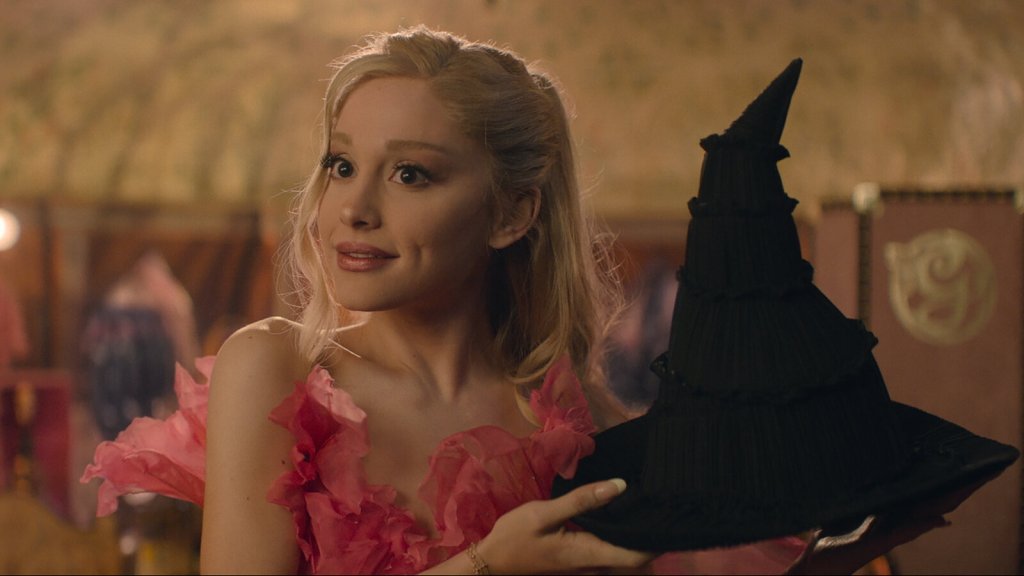
But what isn’t an eyesore is a lot of the beautiful set design the film has to offer. Gorgeously constructed sets of stone and crystal look phenomenal, with some of them really tying into their musical sequences, like the revolving library in the aforementioned Dancing Through Time scene. Most of the time the presentation of these scenes is pretty serviceable with the choreography and blocking, though I did find how these scenes were presented to be occasionally boring, both from a directing and cinematography standpoint. This is the same director as In the Heights, a film I thought did a lot of creative things with how it utilized the city as a focal point of the film, and I didn’t really find that here. But John M. Chu isn’t completely sauceless here, I just found him to be a bit lopsided. There’s a moment of dancing between Elphaba and Galinda with no music that really moved me in its simplicity. It was the most I was moved by the whole film, which feels like an issue, considering this is a play with Defying Gravity as the final song. That scene, though impressively performed by Erivo, is so drowned in ugly CGI and messy presentation that those booming vocals didn’t have the intended effect on me like they were anticipating. I don’t know, these are things most people probably won’t care about, but after getting spoiled with stuff like 2021’s West Side Story, I know more can be done here in the visual medium.
Wicked is bound to satisfy fans of the stage performance as it faithfully brings its charm and energy to the big screen. But if you’re like me, someone who has only heard the soundtrack and wasn’t all that pulled in by it, you may not be as electric for it. Thankfully its leading ladies dominate their screen time despite a handful of elements working against them. It does feel very long and doesn’t always manage to maintain its momentum, but I’d be lying if I said I wasn’t interested to see where this goes. Especially because theater heads have told me the back-half of the play is the least interesting part, so I guess we’ll see. But yeah, it’s a fine enough film underneath modern trappings like poor lighting and so-so visual effects that haunt me to no end, but families are still sure to like it. Can we just stop with Best Picture predictions for it already? Recency bias feels like a hell of a drug.
RATING

GALINDA FIZZ

Known for being bubbly (both in personality and as a motif) Galinda felt like a great subject to center a cocktail around. I decided to do some experimenting with bubblegum flavored vodka, a flavor that may be divisive as it’s not a typically culinary ingredient. But, when paired with cooling peppermint and sweet raspberry, I think it creates something magical. To really up the magic of the cocktail (along with its sweetness and color), I made a sparkling wand from a Blowpop and pink sanding sugar that you can use as a stirring device that also adds a little bit of sweetness to the cocktail!
INGREDIENTS
- 2oz bubblegum-infused vodka
- 1/2oz lemon juice
- 1/2oz peppermint schnapps
- 1/2oz raspberry liqueur
- Top: Soda water
- Garnish: Pink sugar coated Blowpop
INSTRUCTIONS
- Add ingredients to a tall glass, with the soda water being last.
- Coat your Blowpop with the sugar, using either lemon juice or your own saliva (if you’re making the drink for yourself)
- Stir the drink with the Blowpop, adding additional sugar if you’d like to play with the color.
- Add ice.
 The Martini Shot