
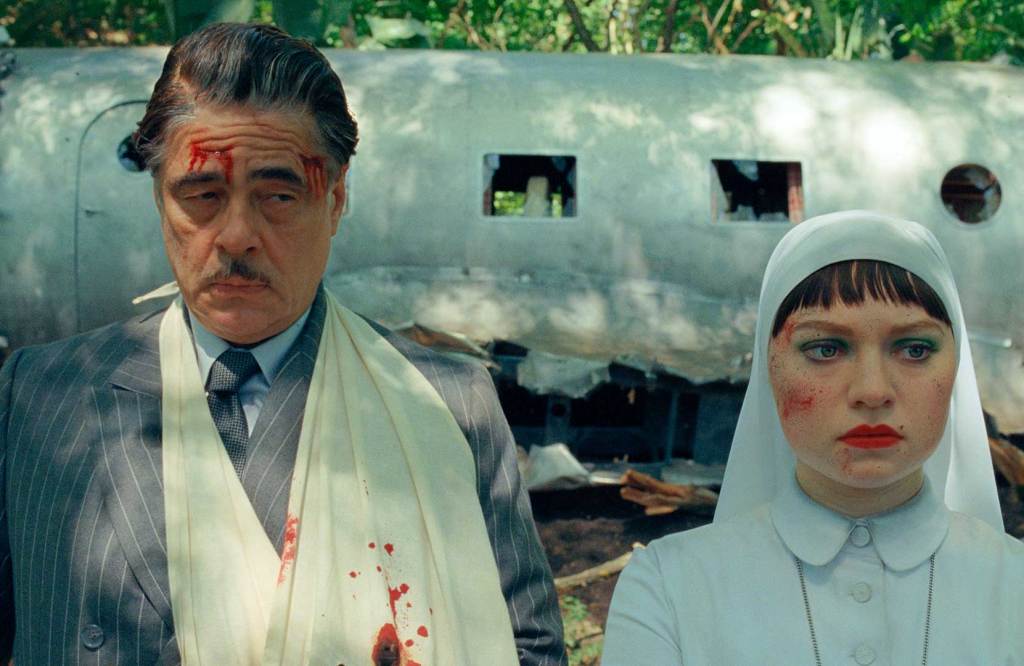
Wes Anderson, perhaps America’s most chic director, has returned to once again give us a little bit more of what we love so much or despise depending on who you’re talking to. You know the style; the symmetry, the pastels, the dry, quirky humor, the complicated family dynamics. Yeah, I don’t think we’re exactly going to be getting a big, subversive surprise from the director any time soon, but he has been able to do quite well with what he feels comfortable with.
About two years ago, I reviewed Asteroid City; Anderson’s latest film at the time that I liked, but didn’t love. It’s by far one of the director’s most ambitious narrative vehicles to date, but that also made it a bit difficult to latch onto and understand, at least for dum dums like me. But, I’m still always excited to see what he’s got cooking next, as no one is really out here doing it like him. Those AI Wes Anderson videos think they’re doing it, but I’ve seen more understanding of the material from Silly Putty.
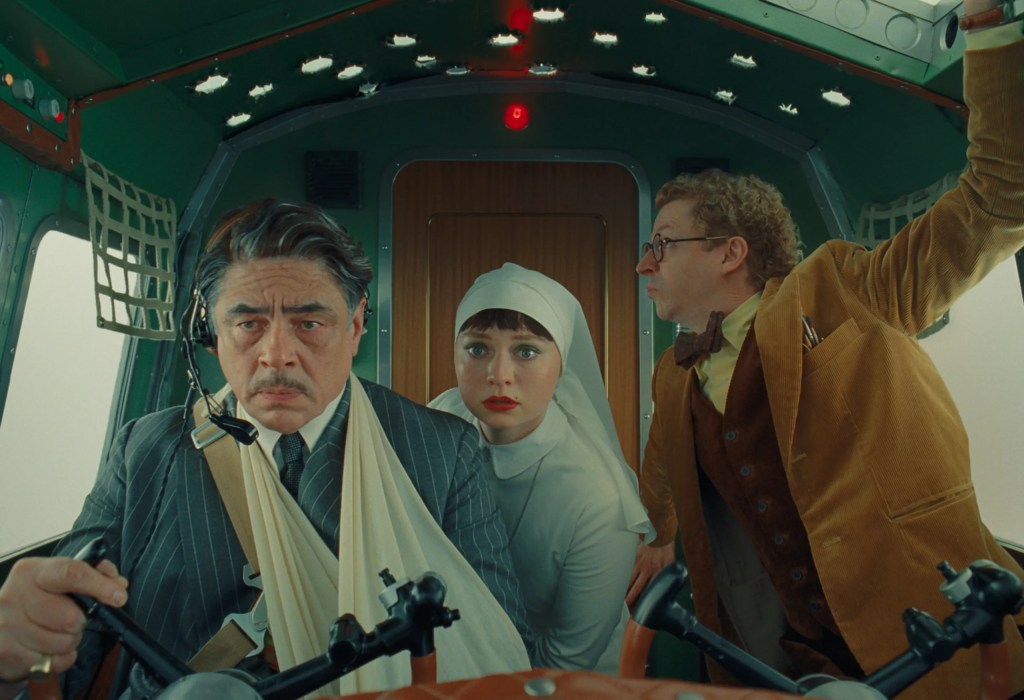
The Phoenician Scheme is everything I’ve already said his films are; expertly crafted if not a tad redundant when you look at the bigger picture of his filmography. It’s not exactly tapping new ground when it comes to his style or themes, but that doesn’t make it any less enjoyable. The performances are incredibly solid, perfectly forming themselves around the offbeat structures Anderson creates. Additionally, the set design still remains staggering, containing so much of the ornate and crafty charm that can be found in his other films. It’s shot and scored beautifully, and I feel like I say the exact same things every time I see his films. What really brought this around for me is that it may be his funniest film since Isle of Dogs, helping distract from the fact that this may be the most straight and narrow of his last few films. The themes and explorations may feel a bit too familiar at times, begging the question of what Anderson has left to say about the unorthodox family structure. Short on pondering but big on laughs and thrills, The Phoenician Scheme continues to teeter the line of Anderson parodying himself, but that doesn’t make this any less of a blast.
After too many failed assassination attempts to count, world-maligned industrialist Zsa-Zsa Korda decides it’s time to finally prepare for his inevitable death. This involves reconnecting with his estranged, devoutly Catholic daughter Liesel and entangling her in a philanthropy scheme so convoluted and incendiary that it threatens to blow up in their collective faces. Traveling across the globe to try to both swindle and appease his partners, Zsa-Zsa begins to wrestle with the demons of his past and what his legacy truly looks like after a lifetime of wrongdoing.

It’s essentially a daddy/daughter adventure that looks to convince one another to leave their chosen life behind for one that they see fit. Zsa-Zsa, played impeccably by Benicio del Toro, understands the power that money, land and shady business dealings hold in the world and desperately tries to impose this belief on his only daughter, who he feels he has wronged the most. On the other end, Liesel, played by Mia Threapleton, has devoted herself to the cloth and sees her father’s livelihood and immoral, aiming to use his fortune in a helping way if it were to land in her lap. Zsa-Zsa is slowly putting the pieces together that maybe, just maybe, the immoral way he’s conducted his life could be not only the reason he’s wanted dead by many, but why he’s failed Liesel as a father. He thinks bringing her into his world and sharing what he’s amassed will be enough, but the journey towards redemption in both Liesel’s eyes and a higher purpose may require taking a step back and seeing exactly where his true ambitions lie. Del Toro delivers perhaps one of my favorite performances of his to date, while relative newcomer Threapleton is no short of solid in her own right. The stiltedness of Anderson’s dialogue and narrative style does keep their rekindling from feeling as emotional as it could have been, even by the director’s standards, but they do phenomenal with what they have.
Of course, there’s also no shortage of Anderson regulars rolling up to the party this time around. Familiar faces like Tom Hanks, Bryan Cranston, and Benedict Cumberbatch all leave their marks in memorable ways. God is in this too, and you can probably guess who plays him. But at the same time, actors like Scarlett Johansson and Richard Ayoade don’t feel like they were utilized to their fullest potential. They’re bit parts, but play enough of a role beyond just being a cameo that I couldn’t help but want more from their characters. Then there’s Michael Cera, who, no, has not been in a Wes Anderson film before. Seems like a no brainer, right? Well, he finally found his way into the mix, and he’s easily one of the highlights of the film. His awkward yet assertive Bjorn feels like an encapsulation of what you would guess a Wes Anderson protagonist could be, but he has a payoff that’s very funny and hilariously subversive for both the character and the actor.

Wow, a Wes Anderson film has stunning visuals, set design, and camera work? Who would have thought? It feels redundant to try and sell you on the visuals of the film; if you know the director, you know what you’re in for. That doesn’t take away from how phenomenally everything is structured and blocked, but at this point, it’s like getting excited because I found a fork in the kitchen. I will say though, this feels like perhaps his most violent film to date, as weird as that is to say. You aren’t gonna see the kind of gore or viscera that’s gonna make you puke in your popcorn, but I’d be lying if I said I wasn’t genuinely shocked by it. The opening scene of the film has a man being blown in half by a bomb, presented with the slapstick goofiness of an off-broadway play, but its ridiculousness is no less effective in a way. And the whole film is consistently surrounded by death, whether as a threat to our characters or as a road toward self-reflection. Not exactly new territory for the director, but the gleeful lean into the violence, along with the apathy it generates because of its cartoonishness, is wholeheartedly connected to the film’s capitalist critiques.
These themes are quite obvious once you make your way through the convoluted setup only really made convoluted because of Anderson’s own winding and winded approach to dialogue, but once you get through that, the rest of the film is a thrill. His love for classic capers and romps is apparent, and the film is easily at its best with that love at the forefront. Plus the comedy is pretty consistent throughout, from a basketball game in a tunnel to a battle between brothers. Not exactly gut busting, but it provides a steady flow of sensible chuckles. The returning ideals of fixing the broken family machine are probably the film’s weakest aspect, feeling noticeably not as dense as Asteroid City’s take on the idea. They’re just effective enough to make you give a damn about these characters, but it doesn’t entirely leave you with much to stir on either. I do think this has one of the more interesting approaches to religion commentary I’ve seen in a while, especially for one that’s seemingly pro-religion. It’s not exactly preachy about it, but rather calm and honest about what gravitates people toward faith and the good that can come from it even if you aren’t a devout nun. I can’t remember the last time I saw faith used in a way that wasn’t either a full-on hit piece or a God’s Not Dead style joint. I do wish it had more of a presence throughout the rest of the film, as it does appear rather abruptly by the end, but still, not a bad touch.
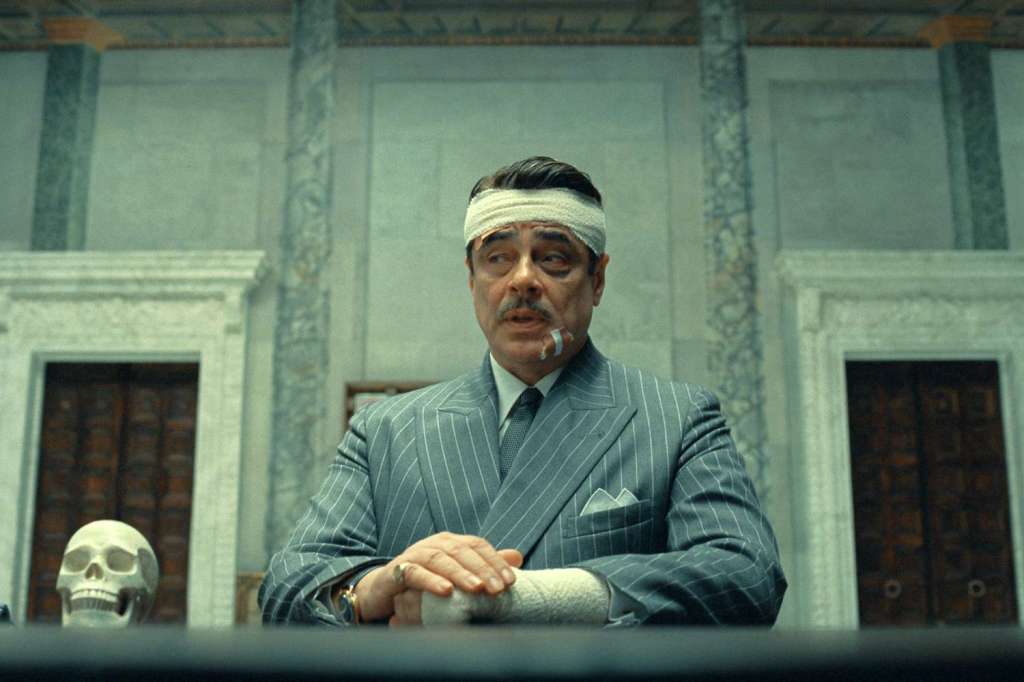
It feels weird to have both really enjoyed this, yet recognize where it comes up short. Far from the most meditative or introspective of Anderson’s work, The Phoenician Scheme succeeds on vibes and energy that just makes this a great, relatively simple watch. Now it really begs the question how much longer this kind of style and approach can really hold me. Sticking to it is sure to generate plenty of good movies, but it also feels like Anderson needs to find the envelope and give it a good push to fight off those stagnation accusations. The fact that it has all the bells and whistles we’ve come to expect from Wes makes this one of the more unique and stylish films in the corporate espionage genre, but I know there’s more to him than just making a fun watch at the movies. While Asteroid City left me with a lot to ponder over about the universe and our place in it, The Phoenician Scheme only really leaves me wondering if I’ll like it as much as time goes on.
RATING

COMPLIMENTARY HAND GRENADE

It’s customary when you’re meeting up with a friend or business partner to give them a hand grenade as thanks for their kindness. But since “the incident” I am no longer allowed to do that, so here’s a hand grenade cocktail to fill the gap. Reflecting the film’s word traveled identity, this cocktail borrows a good amount of flavors from different corners of the world. It’s a tad smokey thanks to the mezcal, while the turmeric adds an earthiness that pairs so well alongside the tartness of the lemon. It’s a bold, saliva-inducing flavor that I quite enjoy, and hopefully, you will too.
INGREDIENTS
- 2oz mezcal
- 1/4oz arak or absinthe
- 1/2oz lemon juice
- 1/2oz honey syrup
- 1/2tsp ground turmeric
- 2 dashes angostura bitters
- Garnish: Lemon wedge
INSTRUCTIONS
- Add ingredients to a shaker and shake with ice.
- Strain into a rocks glass filled with ice.
- Garnish with lemon wedge.
 The Martini Shot