
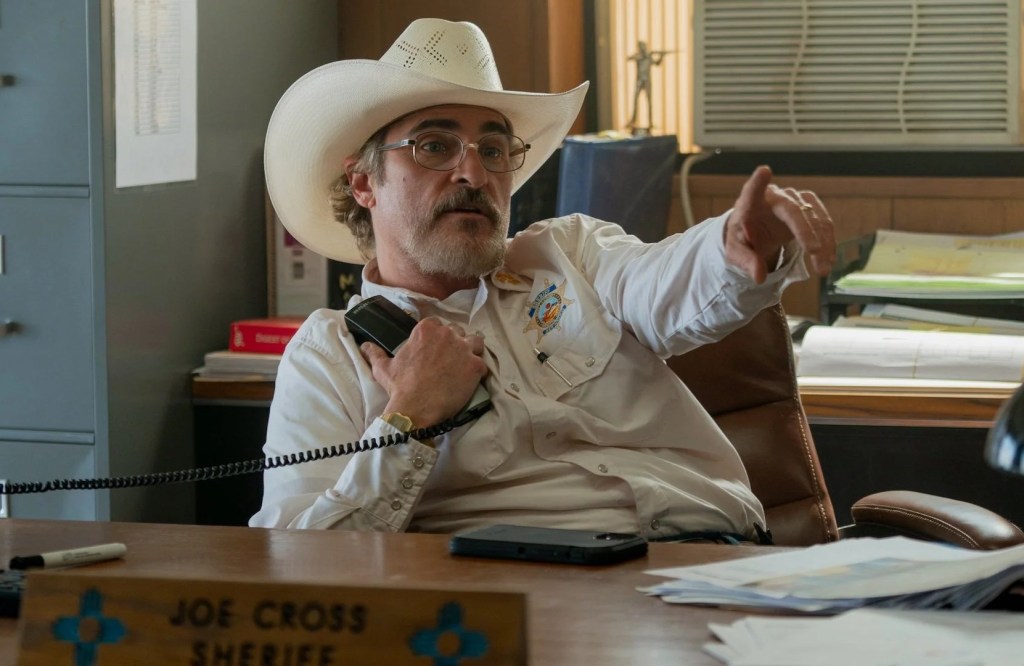
When you’re stressed out, what do you do? Some of us go to therapy, meditate, workout, drink, unfortunately. But not my man Ari Aster. When he’s stressed, he goes out and makes a movie about it. Aster has been around for a minute now, bursting onto the scene with Hereditary, a film I attribute to my rejuvenation on the horror genre, and following it up with another standout horror film in Midsommar. From there, Aster decided to go in a more psychological direction with Beau is Afraid, a nutty and excessive odyssey that added uncomfortable humor and warped reality into his toolbox. There’s clearly a lot of mental anguish not only in himself, but in the world that he wants to dissect and lampoon, which brings us to Eddington. It’s a modern western set during the 2020 pandemic that aims to capture the global psychosis that came with our worldviews being challenged and the entire world being driven inside. It’s a time of divided opinions and warring politics that I’m sure most people want to forget. But as Aster suggests, we can’t, because this isn’t just our past, it’s our present.
Eddington is bound to make a lot of people mad, potentially from both sides of the aisle. His scathing reflection of things like conspiracy theorists and performative activists is bound to divide audiences, and while I understand those sentiments, I think there’s a lot more to this thing than a simple “both sides bad” argument. For one, it’s a very entertaining western thriller, sprinkled with corruption, murder and betrayal. Everything is acted out and presented in a highly engaging manner, but when we get into the bigger picture talks is where this thing gets dicey. A lot of talking points have sprouted out of the pandemic, and Aster does his darndest to tackle all of them. This leaves the deeper meaning of the film as a bit of a mess, but not one that can’t be pieced together to see the intention. I really enjoyed my time watching this and I’m gonna do my best to interpret what I think is at the center of all this. Guess I better take my shoes off with all the walking on egg shells I’m about to do.

On the surface, it’s the story of a sheriff, frustrated with things like mask mandates and lockdowns, who decides to run for mayor of his little New Mexico town. But this is also much more of a personal battle, as his opponent, the current mayor, has a questionable past with the sheriff’s wife, something he has resented him over despite not fully understanding. As the sheriff fights to win, the implosion of the BLM protests throws the town into a frenzy he’s unable to contain, and as his life begins to unravel, there’s nowhere left to go but down. Way, way, down.
Ari Aster may have found his “Scorcese/DiCaprio” pairing with Joaquin Phoenix, because he just knows how to pull out of some of the most pathetic, neurotic performances of all time with him. Phoenix’s Sheriff Joe Cross is a further dissection of masculinity seen in Beau is Afraid, only this time replacing fear with anger. Joe isn’t exactly on the greatest of standings with his wife, his mother-in-law or his town, and the rolling out of pandemic mandates is only making things worse. Despite his role as sheriff, Joe is in a crisis of purpose that he decides to tackle in ways that go from petty to destructive very quickly. I think this is a reflection on law enforcement and how there are moments where they act on emotion rather than reason, which can lead to dire consequences. The film does kinda sympathize with why these moments happen, which ultimately does give layers to this character. He’s not entirely a bad guy, but he lets his personal issues get the better of him while in a position where you really can’t afford that to happen.
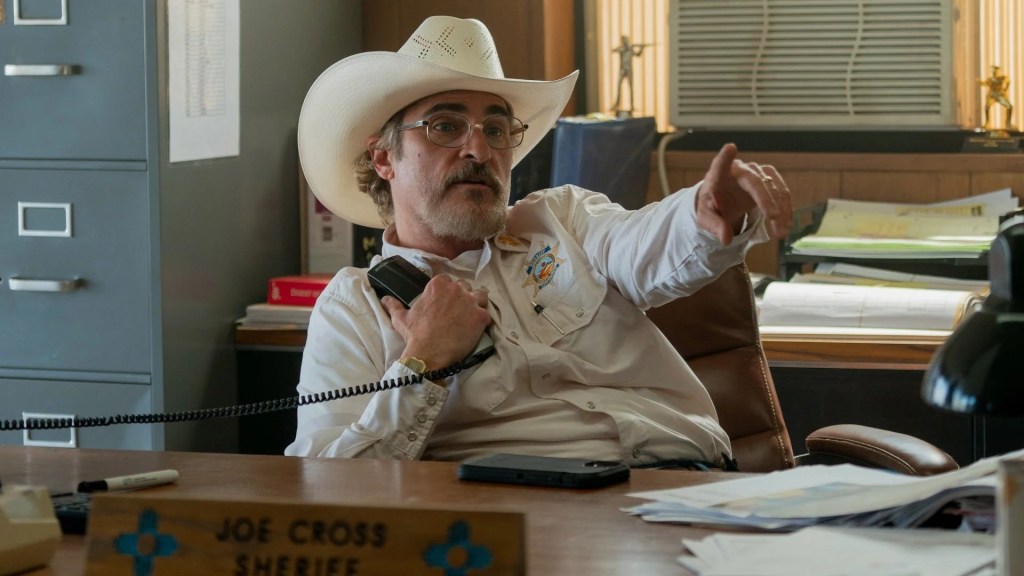
Phoenix is the crux of this film and is phenomenal, but some of the other prominent performances do feel like a bit of wasted opportunity. Pedro Pascal’s Mayor Garcia is a super solid, grounded foil for Joe who shows hints of his own seedy side, but the film never really gets too deep into that. Then there’s Austin Butler, who plays a fanatical cult leader that almost kinda exists in his own little story in the background. Butler is as solid as ever, but the character doesn’t feel completely attached to the story. He definitely is from a thematic side, but his impact isn’t nearly as big as would have hoped, especially because he connects to Joe’s wife Louise, played by Emma Stone. Another super solid actor that doesn’t really feel like they were used to their fullest potential, ending up as blips in the story pivotal to select moments, but not always the narrative as a whole.
If you’re hesitant to watch this because of its surface level label as a “COVID” movie, it’s not really about that. It’s not like The Bubble, which used the pandemic as a launchpad for bad jokes about nose swabs and standing six feet apart. Rather, it’s a bit more like Stress Positions, which uses the pandemic as set dressing to explore the emotional and mental toll something like this has on a population. Nowhere is that clearer than with the film’s take on social media, which is genuinely one of those most authentic and well-entuned uses of this plot point I think I’ve ever seen. That and the internet became such an integral part of that time period as people relied on it to communicate and give their opinions, which of course, sparks a mass outpouring of conspiracy theories and heavy emotions driven by our need to make sense of the most confusing time in our lives. Joe is perhaps the embodiment of that, going from being upset over mask mandates to running for mayor to making egregious, unverified accusations all within the span of what feels like two days. While he tries to block out the constant outpour of conspiracy theories spouted by his mother in law, he ends up engaging in those same practices in real life. This also spirals into things like racial tensions with his single black deputy, which is played for laughs at first before things start to get very, very real.

But while the film pokes fun at the aggressive, sometimes reality defiant nature of one side of the isle, it also targets activism, both of the genuine and misplaced variety, perhaps even more. There’s a subplot involving two boys getting involved in BLM protests purely to win the favor of a girl they like, showing the performative hollowness that can come from trying to do the right thing for the wrong reasons. I get where people feel like some of this commentary is a bit out of touch, and I’ll be honest, I did kind of agree at times. While the film feels like it has way more to say about teens blindly protesting violence rather than the violence that sparked it, I really don’t think that’s the case. I think there are some truths that hit close to home, but I couldn’t help but keep thinking back to Beau is Afraid while watching it.
That film is drowning in absurdity, and the film is not afraid to let you know that. It’s unreal and bizarre and there’s a freaking giant penis monster in it for God’s sake. For Eddington, I don’t think Aster left that absurdist realm; he’s only made it more subtle. The way I view this film is that it’s almost a parody of a typically right-wing style of story told through the lens of Joe, who reflects how Aster actually views that ideology; driven by unprocessed emotions and confusion that turns into anger. I mean, it’s a story about a small-town sheriff trying to “protect” his town from an invading ideology, which is manifested into a heavily artillery shootout with an ANTIFA inspired threat. And yet, Joe is bumbling, trigger happy and willing to do bad things to protect his own skin. It’s surrounded by the exact parodies the right likes to make with a parody of the right in the center. Viewing this through more of an absurdist lens like Beau is Afraid doesn’t remove the commentary it’s trying to make, but it does a better job to contextualize it. Sure, maybe it could have been more overt and direct, but we don’t keep talking about the direct and simple films after they’re done, do we?
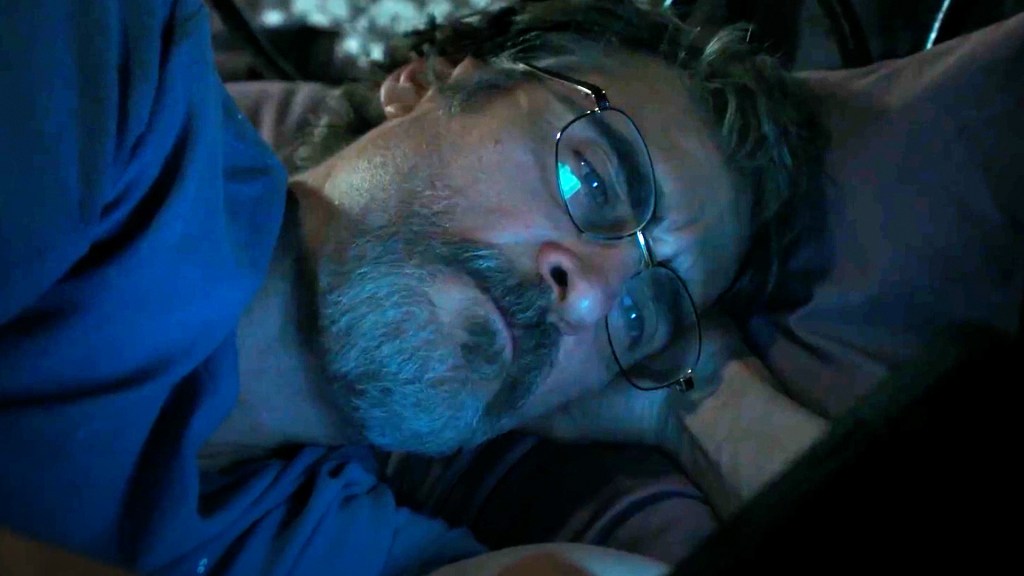
That’s at least how I view it. I know people are gonna be pissed about it one way or another, but I’m just glad to have gotten a hell of a modern western. Eddington uses an uncomfortable turning point in our lives to create a darkly funny yet incredibly depressing reflection of the societal regression we found ourselves in. The way it frames the internet as the looking glass into our collective insanities is quite poignant, finding a very impactful way to reaffirm what we already know. The finger pointing can feel misguided at times and it may not hold the definitive answer to fixing this mess like some may hope, but it’s still a hell of a film at its heart. It reminds us of our own fallibility as humans, but if we’ve already made it a few thousand years, I feel like we can make a few thousand more. Please. I’m begging yall. Let us live long enough at least until I can see that third Spiderverse movie.
RATING

SIX FOOT STANDOFF

This cocktail is going to pull a bit from the film’s New Mexico setting with a riff on a cocktail called the Chimayo, which was created in the state back in the 1960s by Arturo Hara-miyo. Instead of tequila, I’m gonna be incorporating mezcal, as the smokiness of that reminds me of whiskey, which pairs quite well with apple flavors. It’s also going to have a little bit of angostura to spice it up a bit and round the whole thing out. You may now lower your face masks and take a sip, but not for too long, you hear?
INGREDIENTS
- 1.5oz mezcal
- 1/4oz creme de cassis
- 2 dashes angostura bitters
- 1oz apple juice
- 1/2oz lemon juice
- Garnish: apple slices
INSTRUCTIONS
- Add ingredients to a shaker and shake with ice.
- Strain into a coup glass.
- Garnish with a few apple slices.
 The Martini Shot
One thought on “Eddington – REVIEW & COCKTAIL”