
Over the past decade or so, people have had both quite a lot to say about the Avatar franchise, and also, nothing at all. The epic sci-fi series helmed by one of the undeniable GOATs, James Cameron, has befuddled and confused many people. The original is one of the highest grossing movies ever and yet people have claimed that it has had no cultural impact. Maybe there’s an argument for that to be made, but to see the real impact this series has had, you have to look a little deeper.
Say what you will about the story or the characters, but these films have fundamentally changed filmmaking technology, advancing the techniques and tools used to create something we’ve genuinely never seen before. That’s kind of Cameron’s M.O., isn’t it? The guy has pushed the boundaries of what’s possible through film his entire career, and while that doesn’t mean I’m exactly head over heels with everything he’s done, it does mean I respect the hell out of him as a director. There was always something to prove in his intent, so what happens when that doesn’t seem to be the case. Well, you get Avatar: Fire and Ash, a film that feels more like an obligation than a game changer.
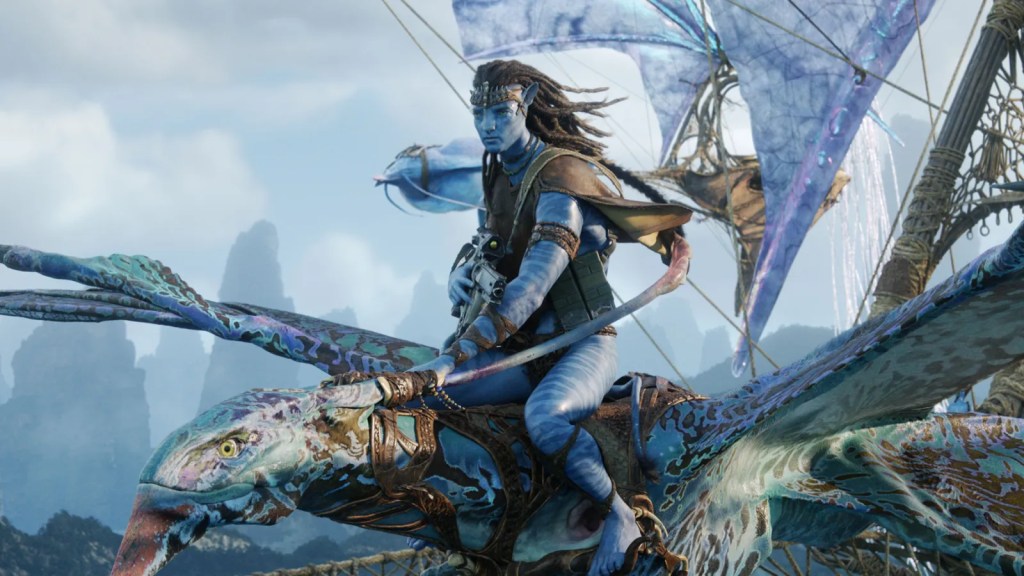
After The Way of Water fully brought me back into this world and psyched me up for the next installment in this trilogy, I couldn’t help but walk away feeling a tad disappointed with this outing. Everything I admired about the previous films is there; the incredible world building, the fantastic sense of scope, and of course, the unbelievable special effects. But without the revelation that came with the first Avatar and the large gap between the sequel that gave time for the visuals and story to reaffirm itself, it made me take notice of more of the issues that have carried over from the other films. While I think there’s a lot more depth to some of the characters and relationships than one may think, the storytelling didn’t always do these ideas justice for me. The family dynamic, despite its loss and hardship, just never really gripped me like I had hoped. I think a lot of this came down to the writing, which lacked the nuance and, ironically, humanity to fully invest me in the Sully family’s plight. Additionally, it felt like Cameron had nothing new to really show us, leading to the film feeling like a retread of themes and setups most of the time. Its saving grace is still the sheer impressiveness of the visuals, but it just simply wasn’t enough to make me love this like I had hoped. But even with those complaints, these films still remain unlike anything else you’ll see at the movies, so that’s gotta account for something.
I’ve gotta say though, I’ve enjoyed seeing Jake Sully evolve into an actual character. I was pretty low on him as a protagonist in the first one, but Way of Water and this one really did win me over on him. While his external conflict has now gotten more personal, thanks in part to a fully-fleshed family that’s already taken one casualty, it’s that internal conflict he experiences that finally puts some layers on him. He’s a guy caught between two histories; humans and the Na’vi. That human side begins to slowly slip away, but it’s his relationship with his adoptive-human son Spider that becomes the mirror that reminds Jake of the most important aspects of being human. After all, Jake was Spider at one point, being an outsider initially seen as a burden who would later come to be accepted. The film is all about building these parallels, and there’s perhaps no more prominent parallel than the one between Jake and Quaritch. Full stop, Quaritch is the moneymaker out of this whole operation in my opinion. He’s by and large the most intriguing and compelling character in the whole story; a man given new life in the body of a creature he’s trying to destroy. It’s that poetic irony that often draws him towards these self-destructive tendencies, especially the one that involves bedding a crazy native. Every deployed man’s dream. But Quaritch has been given the same pitch as Jake, and the fact that Quaritch refuses to accept that reality is quite interesting.
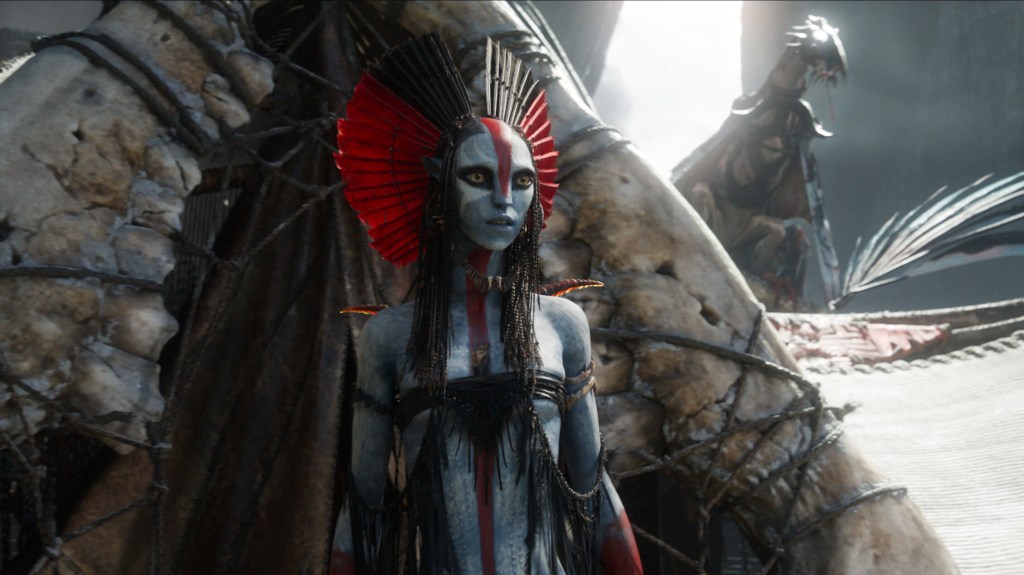
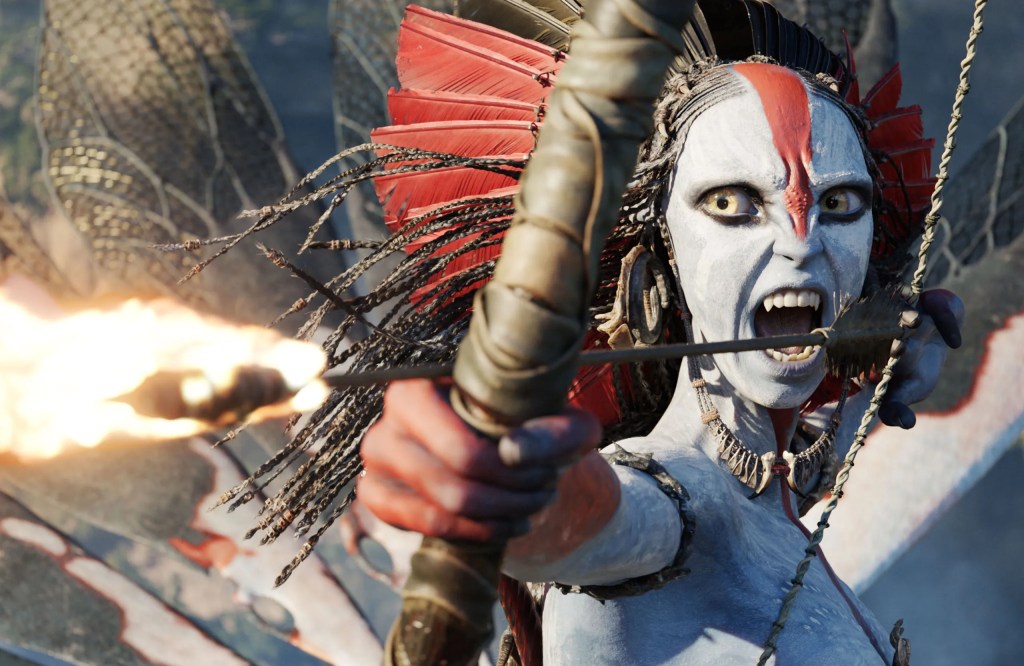
Unfortunately, the rest of the fairly large cast didn’t really compel me as much as Jake and Quartich. Elements to the story, like Kiri’s vision quest and Lo’ak’s redemption in the eyes of his father, just don’t scratch that same itch. Sure, they move the plot forward at times, but it’s rarely in any greater service to their characters. There seems to be a hesitance from Cameron to fully pull the trigger on a lot of character arcs, which I guess is to leave room for expansions in future sequels. Yeah, that’s right, there’s probably more Avatar to come, so this film kind of goes in a direction that feels both open-ended and case closed. If this were to be the last one, it does end of a fairly satisfying curtain call, but there would be plenty of questions left unanswered. As for the newest Na’vi tribe, the fire-crazed heathens known as the Mangkwan tribe, I kind of wish we got to spend as much time with them as the Metkayina tribe from the last film. They’re much more of a savage army built to fight the heroes rather than a culture we get to fully explore, aside from Quartich, who actually hilariously goes full-blown native, only deepening the complications of his character and desires.
Hey, did you know the visuals in this film are incredible? Cool, glad we got that out of the way. Trying not to sound like a broken record here because it’s what everybody hypes up, but it deserves all the hype. Granted, these films are operating on twice the budget of even the biggest modern blockbusters, but I still cannot get over how well crafted the visuals are. It truly is fully immersive, with not even a stitch of a seam in sight to make you believe you’re anywhere but Pandora. And luckily, Cameron does a fine job at harnessing the visuals when it comes to its more involved action scenes. I’m familiar with the process of how these are made, but even still, I found myself asking how in the hell they were able to do this. From a sky-high convoy assault to an explosive dash through a foundry turned futuristic city, breathtaking sometimes doesn’t even do these scenes justice. If I had one complaint, it’s the very obvious frame rate differences. There’s a lot of high frame rate moments that almost kind of erase the groundedness of the visuals, often making it feel like a video game cutscene. There is such a thing as being too fluid, and I think this film may have dipped their toes a tad too deep into it.

At some point, a thought began to dawn on me as I was watching; this feels very much like a much bigger movie was chopped in half and then split into two different films. That became my biggest issue with the film is that feeling of repetition, of circling back to moments and ideas that I thought Way of Water already covered well. Of course the “found family” theme has been stretched across the entirety of this trilogy, and I think it might have reached its limit here. I felt as though we were fed the same conflicts and resolutions that we already experienced in past films rather than trying to take those ideas into a new direction. The sense of belonging in the Metkayina, the plight of the Tulkan, the entire climax of the previous film. All of these elements of the past film are returned to once again here, but not in a way that feels like much has changed. I’m not kidding, the climactic final battle is incredibly similar to the one from the prior film, with very similar settings, build-ups and payoffs. It feels less full-circle and more not really knowing what else there is to say, and I think that’s what kind of stuck with me the most. It feels more like Way of Water Part Two rather than Avatar 3.
And that’s what I was getting at at the beginning of the review. James Cameron’s past films had a certain mission or intent behind them. Much of his heaviest hitters ended up changing the game in one way or another. Terminator 2 revolutionized computer-generated characters, Titanic advanced settings of larger scope with incredible realism, Avatar opened the floodgates to put nearly anything you want on screen. Hell, even Way of Water had something to prove, pushing the technological grandeur of the first film even further while proving Cameron still had what it takes to deliver on monumental blockbusters. And don’t get it twisted; Cameron still has the sauce, even here. Unfortunately, that passion and drive just doesn’t feel as apparent here, as the film often reads as a story that Cameron isn’t impassioned to finish, but is obligated to. Maybe it’s an unfair observation, given how this film lacks the technological progression and stakes that Way of Water presented, but it just feels like I’ve been here before, something uncharacteristic to Cameron’s work.
Avatar: Fire and Ash still does certain things lightyears better than most of the biggest Hollywood franchises, with stellar effects and visuals that completely immerse you. But when it feels like the envelope isn’t being pushed as far as it could have been, mostly from a narrative point of view, its weaknesses start to shine more than you’d hope. Feeling far too familiar and lacking some of the nuance that elevates these characters from placeholders to fully flesh beings, this is most likely my least favorite of the trilogy, and yet it’s nowhere near what I consider a bad movie. If you didn’t have the patience for the other films, I don’t see this winning you over, but it still remains a theatrical spectacle that often more than justifies that $25 IMAX ticket. If these prices get any higher, they better start splashing me with water and pumping sea salt through the air vents, because I’m gonna want the full Avatar experience.
RATING

ASHES OF EYWA

This cocktail is inspired by the Mangkwan tribe, a collection of Na’vi that had their home destroyed by a volcano, and have thus, abandoned the teachings of Eywa. Seems a bit extreme when you have an afterlife where you can see all of your loved ones, but hey, you do you. Anyway, this is a bit of an interesting one, as we’re gonna be bringing a bit of heat through harissa. I haven’t used this on the show yet but I think it’s a good way to add some spice while also making the drink a tad exotic. The combination of that, pomegranate and mezcal are gonna make one interesting flavor pairing, alluring enough to make you turn your back on your god. Not really, but if you are looking to convert to the Church of Martini Shot, I will be holding confessionals
INGREDIENTS
- 1.5oz mezcal
- 1oz pomegranate juice
- 3/4oz lime juice
- 1/2tsp harissa
- 1/2oz agave syrup
- 1-2 habanero bitters
- Garnish: lime husk
- Garnish: Crouton
- Garnish: Overproof rum
INSTRUCTIONS
- Add ingredients to a shaker and shake with ice.
- Double strain into rocks glass filled with ice.
- For flaming lime boat, place the lime husk on top of the cocktail, then place a crouton in it. Carefully douse crouton with a small amount of overproof rum. Ignite crouton with lighter or match.
- BLOW OUT AND REMOVE LIME BOAT BEFORE DRINKING
 The Martini Shot