
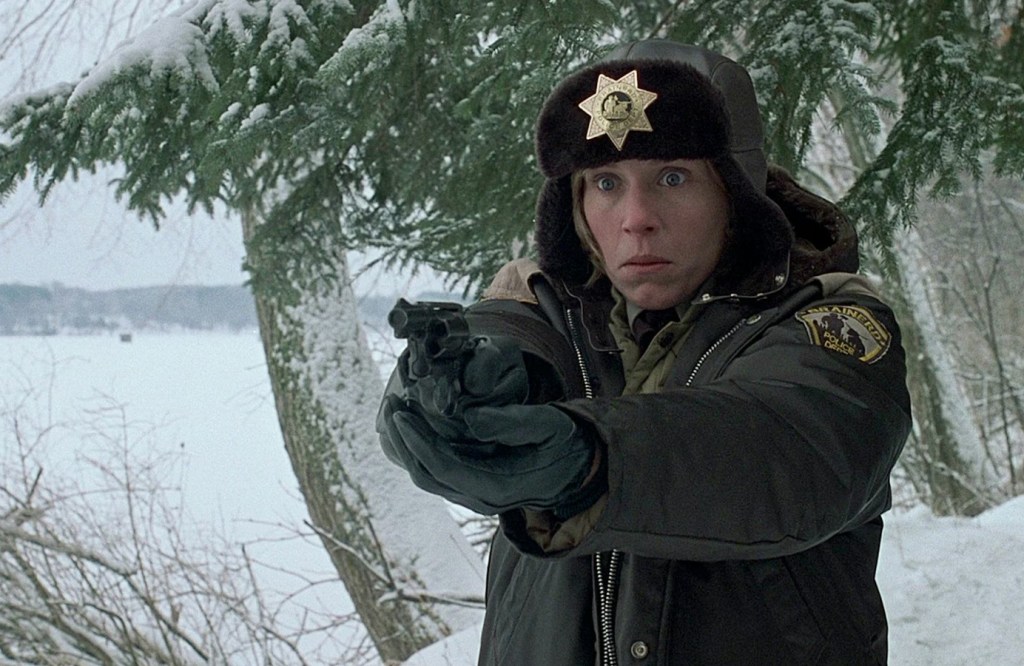
Fargo has been one of those all-timer films that has been in my blind spot until most recently. I’ve seen The Coen Brothers’ other standouts from their run, your Big Lebowski, your O’ Brother Where Art Thou…I’ve even seen Lady Killers, which just by looking at Tom Hanks’ hair, you know you can skip that one. But not Fargo, arguably their most enduring and longstanding film thanks to that longrunning series I’ll probably get around to watching sometime before I die. So, literally a few days ago I watched Fargo for the first time, and if you’re wondering if you should do the same, all I’ve got to say is “oh yah”.
This is one of those quintessential modern crime noir films that just works. The crime is perfectly imperfect, fumbled only by the incompetence of those who commit it and prolonged only by those who haven’t dared dipped their toes into that kind of depravity. Everyone plays their role to a T, from the main cast to people who only get about 30 seconds of screentime. And of course there’s the biggest character of them all; North Dakota. The state is realized in such a detail orientated way, made to look like both a frozen, almost mystical wasteland while also containing honest people with good in their heart…and some with bad in their heart, but really, it’s more stupidity than evil. Everything I know and enjoy about the brotherly duo is on full display here with a film that’s effortlessly funny without reaching for a joke, darkly disturbing when it needs to be, and more than deserving of its status as a certified classic.
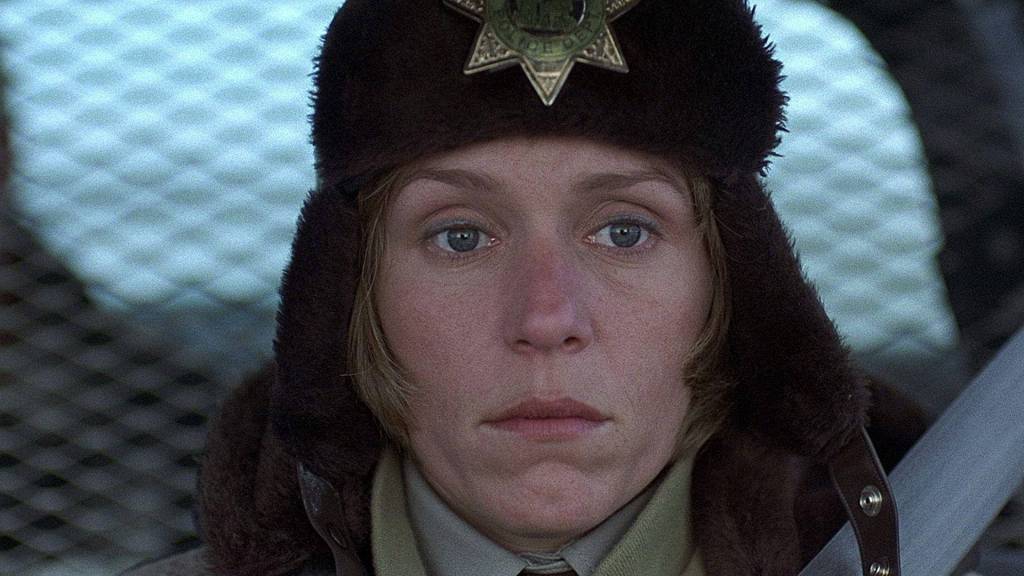
If you don’t know the story, there’s a lot of moving parts at play here. There’s Jerry Lundegaard, a lowly dealership sales manager who’s in need of some money. He gets the bright idea to stage a kidnapping of his wife so that he can get his wealthy father-in-law to pay the ransom and make out with half of the cash. The other half would go to criminals Carl and Gaear, an odd couple of a pairing who seem like they’re bound to cut each other’s throats before this is all said and done. A few stray murders later and that wraps in police chief Marge Gunderson, who sets out on a mission to discover the culprits of the killings at the kind of slow and cheery pace you’d expect from a small town cop.
There’s a lot of interweaving parts here, but everything flows together so fluidly while compounding on itself to make everything infinitely worse by the second. Jerry, played by William H. Macy, will have you wanting to punch your TV the entire time. Jerry isn’t evil, he’s just spineless and stupid, which may actually be worse. He wears the facade of a happy family man when he’s really not. Maybe he feels emasculated in the shadow of his successful, judgey father-in-law Wade, or maybe he just feels he deserves more than he’s got out of life. Either way, he gets wrapped up in a world he is not prepared for, and Macy does a phenomenal job generating only the slightest amount of empathy you can have for a man who orchestrated the kidnapping of his own wife.
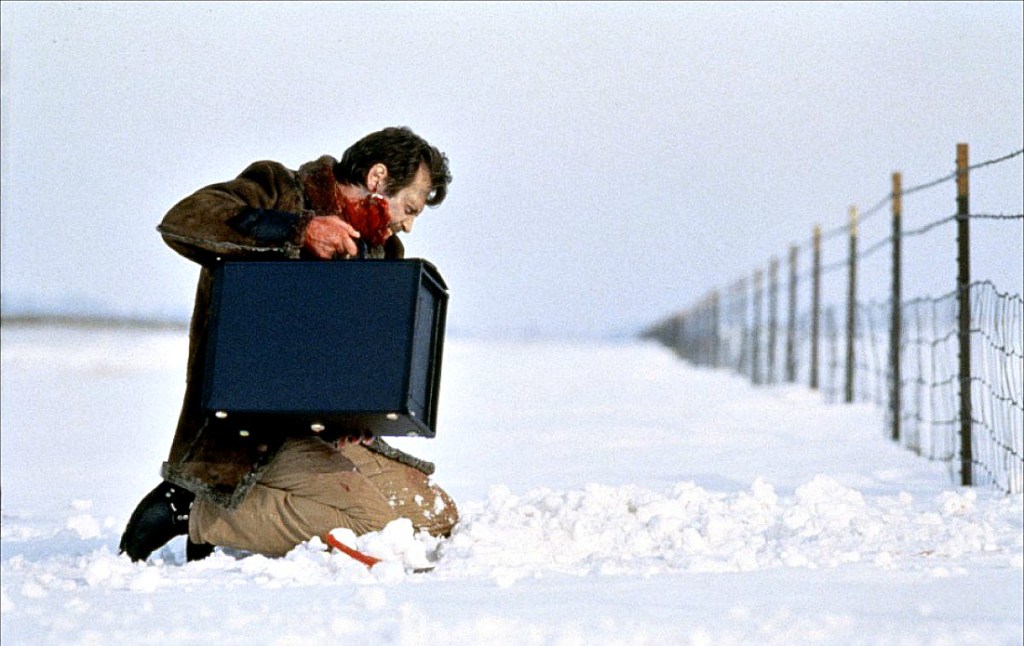
Doing the kidnapping is Carl, played by Steve Buscemi, and Gaear, played by Peter Stormare. They essentially fill the archetypes you’d expect from these actors, but that doesn’t make them any less entertaining. Carl is the snappy ankle biter of the pairing, willing to run his mouth at any given moment, believing it can get him through any situation. Gaear, on the other hand, hardly ever utters a word, preferring to get results with his actions. Buscemi obviously gets a lot of praise for his role here, even nabbing an Oscar nom, but I don’t think you should be sleeping on Stormare either. To me, he’s way more fascinating. He’s often distant, cold and hardly human. At times, it doesn’t even seem like he wants the money. His actions seem driven on a primal instinct even he may not totally understand, really feeling like a precursor to Anton Chigurh, who we would get almost a decade later.
And, of course, Oscar winner Frances McDormand as Marge. Such an endearing and lovable role, treating the severity of these crimes in a way that shows she cares but refuses to let them phase her. She’s the true heart of this whole thing, putting on a brave face while entering a world she doesn’t fully comprehend. She sees this in both tracking down the murderers and her journey into the big city, but by the end, it doesn’t completely jade her, but reassures her in the little things she has. It’s such a tricky role that could have infantilized or dumbed down the protagonist were it not in capable hands, both from a directing and acting standpoint. Also, shoutout to John Carorol Lynch as her husband, Norm. He just brings that much needed warmth that I feel both helps Marge and the audience.
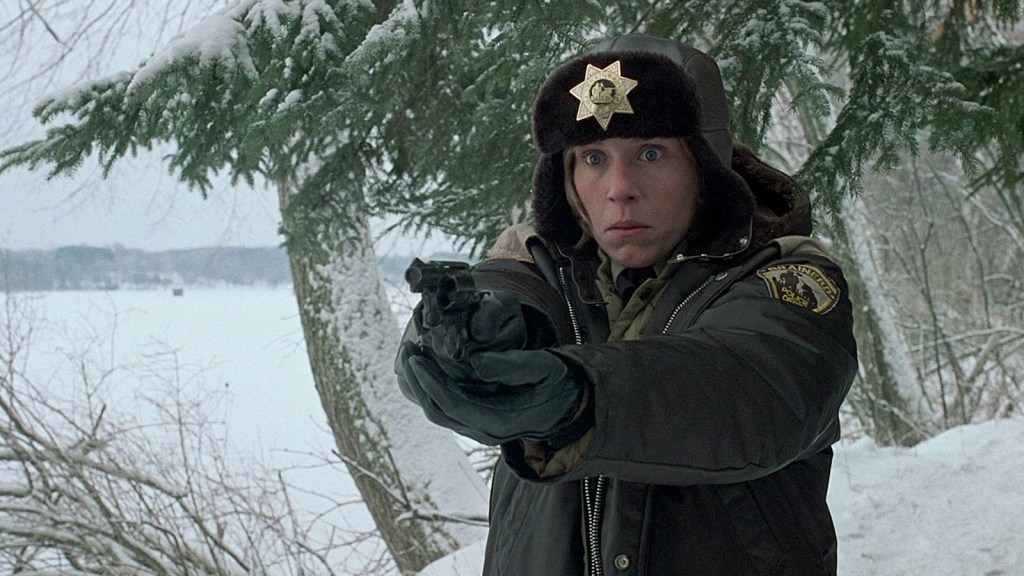
The snowy land of North Dakota is utilized in striking fashion, often having the wide expanses of pure white that somehow feel empty but active. Obviously, it’s used to add further emphasis to objects and color, but it can fully envelope you at times, giving you a well-earned cold feeling that both coincides with the crimes and contrasts with the writing. This may be one of the Coens’ best scripts; not overtly complicated but not trying to push too hard. There’s a lot of simplicity to the comedy in here; the repeating of phrases, the juxtaposition of terrible images with the howdy-doody nature of the characters, and of course, that regional accent. But, at the same time, the darker moments are no less impactful. Sure, it’s kinda funny to see someone murder someone just for talking too much, but at the same time…it’s really not. I think the film has a great balance of dark humor and depressing situations that manage to not contradict and cancel one another. Especially with the end, which, spoilers, if you haven’t seen it. The woodchipper, Jerry’s wails of anguish as he’s arrested, Marge’s inability to comprehend why someone would do such terrible things just for money. It’s all truly harrowing, reminding you that things like this can and do happen, but we’re pulled back into the light by the warmth of our home, our loved ones, and the anticipation of better things to come. It’s a depressing ending, yet one that’s graced with a little less contempt for our main characters who still believe in the good in the world. A rare occurrence for a Coen Brothers movie.
So, suffice to say, I loved this. While I’m not sure if this pushes its way to the very top of my Coen Brothers ranking, it makes a hell of an argument for it. The plot is winding, yet also simple and tight, while the film contains some truly iconic character work that I was unknowingly aware of before even watching the film, speaking to the true impact they’ve left on pop culture. Its mixture of the mundane and the murderous is expertly done, proving both good and evil can come from the unlikeliest of places. So when are those brothers kissing and making up, because we need a lot more of this and a lot less of whatever Honey, Don’t was trying to be.
RATING

CHIPPER WINTER

If you’ve seen the movie, you already know that iconic scene at the end. I took that as inspiration for this boozy ice cream float, capturing both the snowy landscape of the film as well as its brutal violence. While it fits the winter aesthetic of the film, this is just light and sweet enough to be enjoyed as a nice summer treat thanks to ice cream and raspberry puree. Despite the amount of dessert in this, the alcohol can still creep up on you. So take it easy with these or else your toilet is gonna look like the end of the film.
INGREDIENTS
- 2oz whiskey
- 2-4 scoops vanilla ice cream
- 2oz raspberry puree (6oz/1.5cup raspberries/1 cup sugar/1/4 cup water, blended until smooth)
- soda water
INSTRUCTIONS
- In a tall glass, add your whiskey and 1oz of the raspberry puree.
- Top with soda water until you fill it up a little over halfway.
- Add scoops of ice cream until you fill the glass.
- Pour remaining raspberry puree on top.
 The Martini Shot
One of my all-time faves. In fact, I’m due for a rewatch, I think.
LikeLiked by 1 person