
You know that term “too big to fail”? It’s usually reserved for conglomerations or industries that would literally plunge the world into disarray if they were to ever collapse, but I couldn’t help but, for months, assign this same title to The Odyssey. Very dramatic, I know. In truth, if this hulking epic were to have been bad, it probably wouldn’t be the end of the cinematic world as we know. I like Christopher Nolan; he makes good movies. Is he the messiah of what we can still consider “cinema” before AI and factory generated films become the norm? I wouldn’t go that far, but even still, I mentally had a lot riding on this movie.
Love him or hate him, Christopher Nolan is perhaps the only big name director working today that somehow has found a happy balance between market appeal and quality filmmaking. Even legends like Spielberg and Scorsese are no longer considered guaranteed box office success like Nolan. Just look at Oppenheimer. A historical drama not about the bombing of Hiroshima and Nagasaki, but about the guy who developed the bombs and then felt sad about it. This sounds like something you’d find playing late at night in eight parts on the History Channel, and yet it became a billion dollar movie. That really speaks to the talent that Nolan brings to the table, and now, in a world where movies are market tested, overly micromanaged, and practically created by shareholders rather than companies, Nolan has sort of become this bastion for big blockbuster filmmaking, refusing to compromise on a medium that is trying to be watered down and neutered every day.
So, is The Odyssey the savior modern film has been looking for? Well, let me tell you what I know it is. It’s a staggering product of craftsmanship that can’t be easily replicated, no matter how much technology advances. It’s a phenomenal adaptation that doesn’t just look to boringly translate it from page to screen. It views the text through a new, more modern lens that continues Nolan’s hyper focus on the concept of reaping what you sow. And, above all, it’s just a damn good movie that manages to be consistently entertaining, always throwing something interesting or captivating at you while also not sacrificing character growth that makes this more than just pure spectacle. Whether it can be called the definitive adaptation of The Odyssey is hard to say considering there’s no real definitive version of the text. And who knows if this will be the film to get the studio heads out of their studio asses. But for right now, it’s a damn good time at the movies, and that’s enough.
If you’re like me and haven’t touched anything remotely The Odyssey related since high school, fret not, because Nolan manages to make the story pretty straightforward. It’s kind of what I always appreciated about him; despite his rather complex stories, he always finds a way to be as direct as possible without outright holding your hand. Including bits from The Iliad was a smart choice to better add context to the plot, so you can better understand how we got here and where the world is ultimately at. But Nolan does get up to his old tricks by telling bits of the story in a non-linear way, but I promise it doesn’t make it all overly confusing. Much of the plot is actually told through the lens of one character telling the story to another, which is a great touch to reflect the story’s oral history. It jumps around often, but Nolan’s tendency for no frills storytelling keeps things from feeling disjointed or out of place.
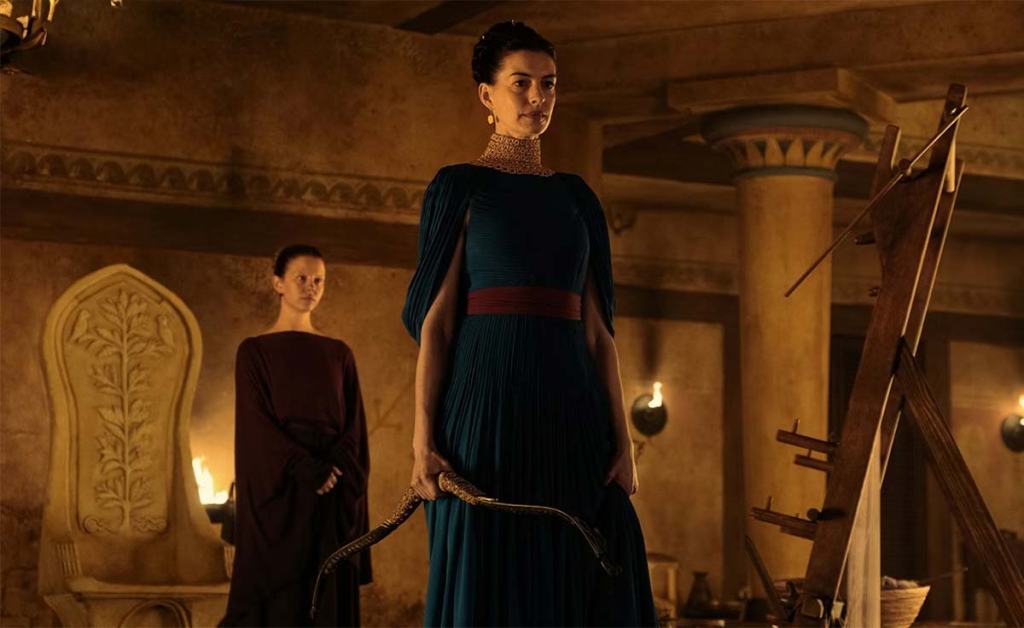
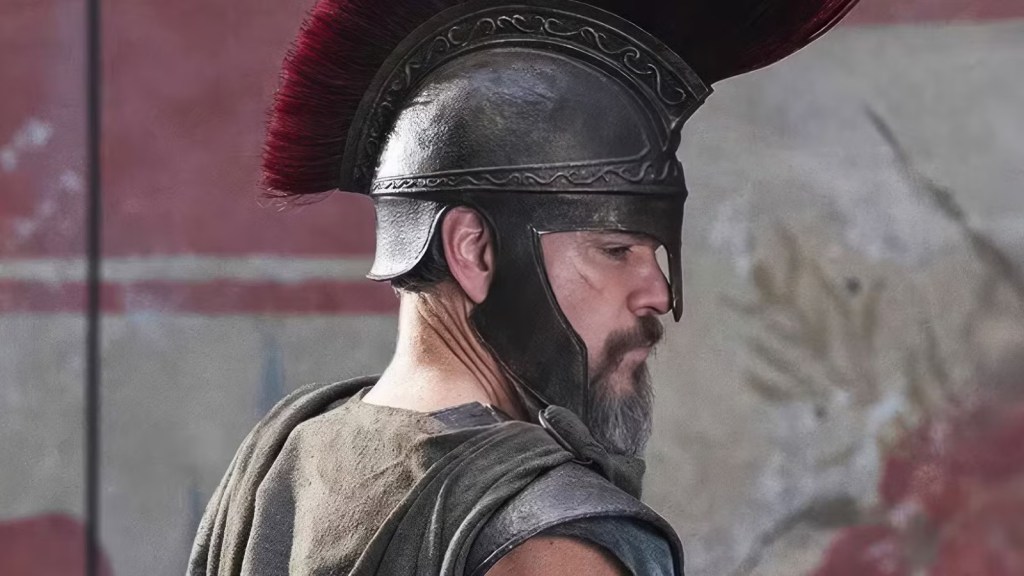
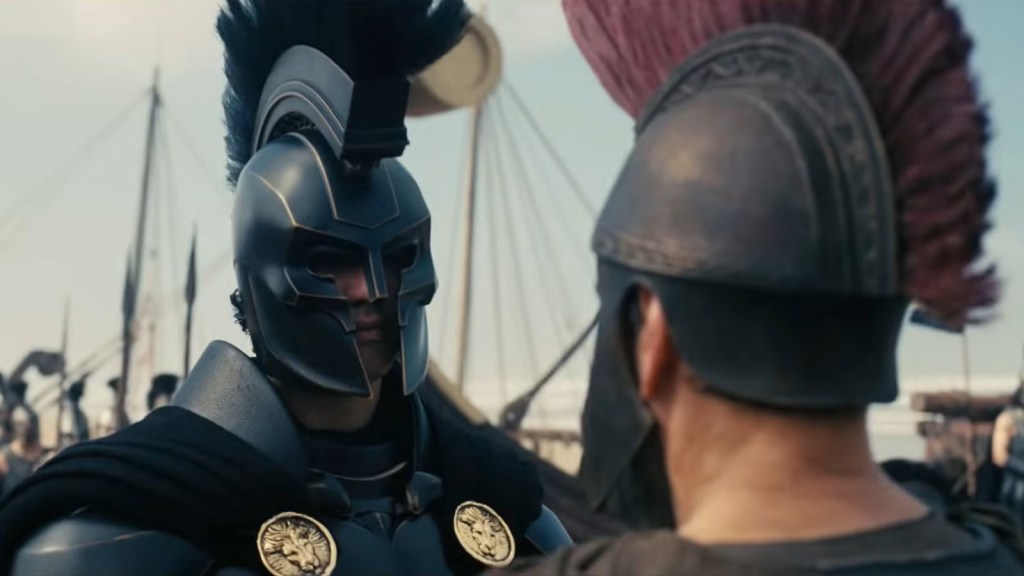
It would be a daunting task to cover the entire cast in a short amount of time, but there are certainly some players worth talking about. Of course, we probably should talk about Odysseus, played by Matt “How Do You Like Them Olives” Damon. Damon isn’t exactly putting on an acting clinic here, but he does a serviceable job as the hero of legend. The characterization of Odysseus is quite engaging, though. Like many heroes of his time, he’s honorable yet succumbs to his own hubris on more than one occasion. There’s honestly a lot of parallels to Nolan’s take on Robert Oppenheimer; both are the center of a significant turning point in history and are reckoning with the ramifications of their role in it. A big wooden horse was practically like the atomic bomb of its age. But Damon’s Odysseus benefits from the actor tapping into not only a place of heroism, but tapping into a place of doubt that his brand of heroism might actually do more harm than good. Let’s cover some other standouts. Robert Pattinson is, unsurprisingly, dominating every scene he’s in as the smarmy, conniving Antinous. John Leguizamo plays one of the most compelling roles I’ve seen him in as Eumaeus, a blind farmer who’s connected to some of the film’s more emotional moments. Anne Hathaway brings a commanding screen presence as Penelope, a woman seen as an object to be won rather than the current ruler of her kingdom. Special shoutout to Benny Safdie’s Agamemnon. He doesn’t do much outside of aura farm, but how can you not with armor like that?
There really isn’t an instance of a bad performance here, although some were a bit more underwhelming than others. I’m still kind of waiting for Tom Holland to have his true movie star moment. You know, that one performance that sort of rockets him to a whole new level of impressiveness. This was not really that performance for me, as his character felt rather restrained, lacking any real screen presence, which is kind of unfortunate considering he’s the son of Odysseus. Same kind of goes for Charlize Theron’s Calypso. A terrific actress who just doesn’t leave her mark on any scene she’s in despite being a pretty pivotal character, though maybe this can just be chalked up to her characterization, as we don’t ever really get to learn too much about her.
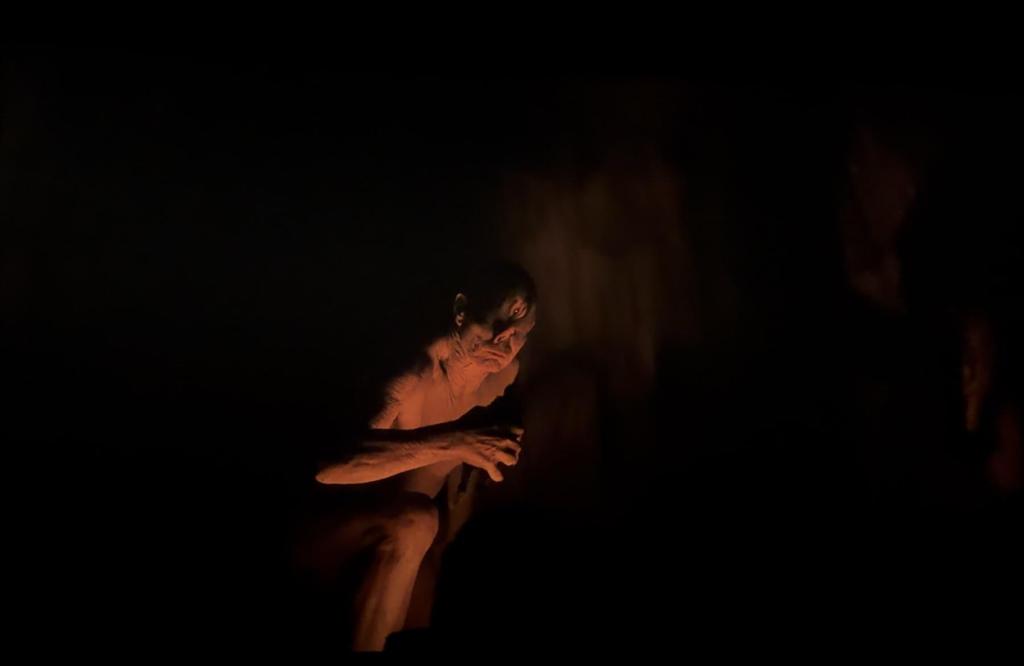
I went into this pretty confidently, thinking that while this was sure to be a spectacle of a film, I wasn’t going to be absolutely blown away by anything I saw in this. Boy, was I wrong. There are some moments in this that are so striking, so mind-burrowing that I was left in shock and awe during and after experiencing them. A lot of this comes down to the complete technical mastery on display here, both in what you see and what you hear. Take the cyclops, for example. It’s a moment I was well familiar with, and yet this sequence made my skin crawl and my stomach twist in knots. The design is downright frightening, existing in the realm of the uncanny valley, but not in a cheap looking way. More like a “bastardization of the human form that makes me wanna cover my eyes” kind of way. Through a mix of practicality and puppeteering, the sequence is staggeringly impressive, and its commitment to not relying on an overabundance of CGI gives the whole thing an old fashioned feel that was super welcome. And God, the sound design. This is a loud movie, and a lot of times it’s meant to make you super uncomfortable. Well, with scenes like this, the dinner with Circe and the Scylla attack, I’d say mission accomplished. And it’s just so goddamn refreshing to have a movie like this and have it not look like it was shot in The Volume like everything else. These settings are gorgeous and mystical just from harnessing their natural beauty. People will tell you on location filming doesn’t make much of a difference, but trust me, it does.
Coming in close to three hours long, the film does occasionally buckle under the weight of trying to cover all its bases, but never to a point where I was finding myself mentally checked out. There’s dips here and there and some repetition in the “soldiers arrive on an island only to be chased off” structure of the story, but everything is heightened with the level of care and attention Nolan is known to bring to his work. But one thing that kinda did take me out of the film from time to time is the decision to use fairly modern, American dialogue. Look, there’s no real right way to go about this, as we don’t know exactly how the ancient Greeks were talking. They definitely weren’t talking in the British accents, which these things tend to default to. But some of the language was just a bit too casual for me. It did make the world feel a tad more natural at times, but other times it kind of made it feel more like a deliberate stylistic choice that didn’t always work for me. I’m kinda down the middle on it, as hearing Tom Holland say “dad” just didn’t feel right, yet Matt Damon dropping an F-bomb felt surprisingly poignant. It’s a mixed bag in that department, but far from an outright negative in my eyes.
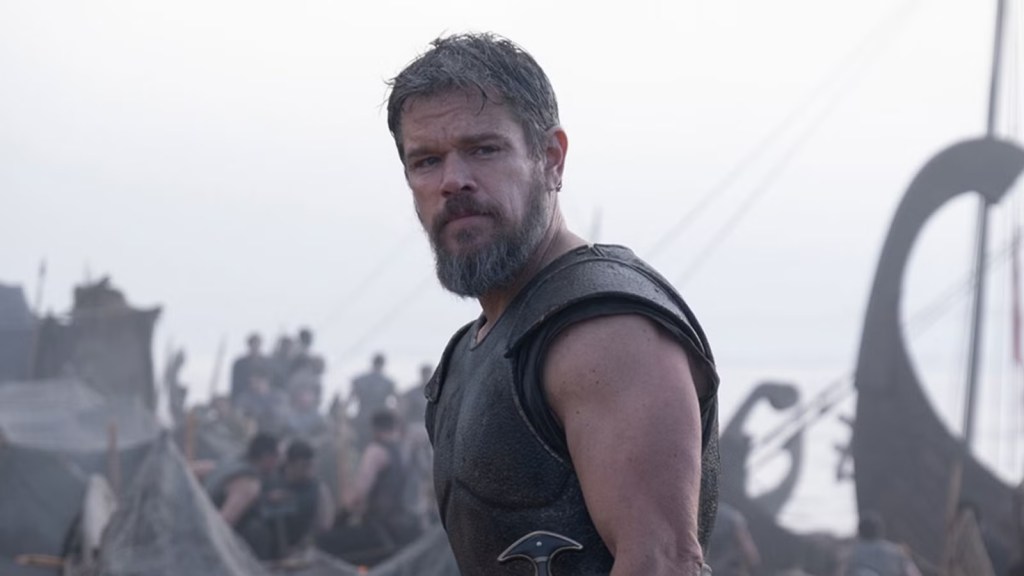
Much of the thematic elements found in the original poem are still present here. Cunning over brute strength, an unstoppable drive to return home and how hospitality is a cornerstone of every thriving civilization. These are universal themes, of course, but what Nolan does with them to make the story a bit more evergreen to our current age was actually really solid. Like in Oppenheimer, the world was irrevocably changed. For that film, it was the atomic bomb, but here, it’s the abandonment of what is known as Zeus’ Law, a universal understanding that the Gods want us to be kind and hospitable to strangers and visitors. This is a cornerstone belief to Odysseus, and yet he partakes in the world’s greatest prank; the Trojan Horse. This “gift” that was used as a way to conqueror Troy goes directly against this belief, and the ripple effects from this one moment begin to affect the entire world. From being turned into pigs to getting demolished by armored giants, Odysseus and his men are not welcomed anywhere, which causes many of them to stray even further from their noble beliefs. But while Oppenheimer was more of a cautionary tale, The Odyssey feels a bit more hopeful as a call to action to return to the old ways of treating others with kindness and respect. Sure, it’s a bit basic and cheesy, but that doesn’t make the truth any less poignant. And it feeds into a super compelling third act that’s so satisfying, so energizing and so invigorating that my theater was clapping through most of it. You’d have thought a plane just landed after some bad weather, but maybe that’s just what Nolan did here.
Even with some minor hiccups and nitpicks here and there, Christopher Nolan’s The Odyssey is pretty close to a miracle movie in this current age of blockbusters. There is an authenticity, a groundedness, a believability to a movie containing giants, witches and unseen, wrathful Gods that the average Hollywood director just wouldn’t be able to accomplish. Not only is this an epic story that resonates with our real world and its issues, but it’s also a personal one, as more and more of Nolan’s outlooks and beliefs have begun to spill into his work, and I’m happy to see it. It’s not trying to be a 100% faithful adaptation of the poem, and I’m honestly glad it’s not. The influence of The Odyssey has been felt in modern storytelling since forever, sometimes overtly obvious and sometimes a bit more subtly. To attempt to retell the build block of storytelling kind of just feels like a moot point. But to question it, reexamine it, reevaluate it, that is what makes this stand out to me. It’s not only a film filled with Nolan’s trademarks, but it shows the continued growth he’s experienced on this creative journey, so while it’s probably too soon to start throwing around “the best” title, we can at least feel comfort in the fact that summer has found its one, true blockbuster.
RATING

POSEIDON’S WRATH

Yeah, I’d be mad if someone stabbed my gross chud son in the eye, too.
You never see Poseidon in the movie, but his anger is felt throughout as Odysseus and his crew just get the dog crap knocked out of them on the ocean. So, to get on the god’s good side, I decided to honor him with a bubbling blue cocktail that contains some of my favorite elements of more Greek-leaning cocktails, particularly crisp mint and anise-flavored ouzo. The addition of sea salt and champagne is reminiscent of the bubbling, salty ocean water, creating a drink that is slightly fruited, slightly dry, and harnessing the anise flavor to make something quite godly.
INGREDIENTS
- 1.5oz white rum
- 1/2oz ouzo
- 1/2oz blue curacao
- 1/2oz lime juice
- 3-5 mint leaves
- pinch of salt
- TOP: Champagne
- GARNISH: Mint sprig
INSTRUCTIONS
- In a shaker, add the mint leaves, salt and lime juice. Muddle the leaves.
- Add additional ingredients and shake with ice.
- Double strain into coup glass.
- Top with champagne.
- Garnish with a mint sprig.


One thought on “The Odyssey – REVIEW & COCKTAIL”